
The 2026 midterm election cycle features a number of U.S. Senate races that could flip and radically alter the balance of power come November. Democrats will be hoping to capitalize on typical opposition party momentum, while Republicans will be hoping a favorable map will help them defend seats and possibly pick up others in key battlegrounds.
All told, the cycle will feature 33 U.S. Senate races, a majority of which will occur in reliably red or blue states. Close to a dozen could possibly change hands given the right national environments, while a total of eight fall in pure toss-up range.
The eight Senate contests most likely to flip this cycle are as follows:
The Tar Heel State has produced some of the most expensive Senate races in U.S. history, and will in all likelihood be the site of another one this year following the retirement of current Senator Thom Tillis, a Republican.
As of early May, the seat is largely seen as the most likely flip candidate after Democrats managed to recruit their preferred candidate in former Governor Roy Cooper. On the GOP side, Republican National Committee (RNC) co-chair Michael Whatley, who also formerly led the North Carolina GOP, managed to easily secure the Republican nomination with the backing of President Donald Trump.
According to the RealClearPolling average, Cooper currently holds a 6.8-point advantage, with some pollsters finding the former governor leading by as much as nine percentage points. Cooper undoubtedly holds an advantage in name recognition, which is widely credited with contributing to the early lead.
Then-RNC Chairman Michael Whatley speaks with attendees at The People’s Convention at Huntington Place in Detroit, Michigan on June 14, 2024
Photo: Gage Skidmore
Cooper also holds a sizable candidate-side fundraising advantage, with $13.8 million raised in the first quarter versus roughly $5 million for Whatley. Cooper also holds a sizable cash on-hand lead as of this juncture, though Republicans possess a major overall cash advantage through massive outside spending — most notably the Senate Leadership Fund’s pledge of at least $71 million to boost Whatley and attack Cooper — which could significantly narrow the polling gap by Election Day.
One recent poll from Quantus Insights found Cooper leading with 48.6 percent of the vote while Whatley trailed with 43.8 percent, a much tighter 4.8-point edge for Cooper close to the margin of error of +/- 3.5 percent. Undecided voters accounted for an additional 5.7 percent of responses, while 1.9 percent selected other options.
In Maine, incumbent Republican Senator Susan Collins is seeking a sixth term in 2026 after first winning election in 1996. Collins, Maine’s longest-serving senator, has built a record as a moderate who frequently works across the aisle on issues ranging from infrastructure to health care. She is the last Republican in New England’s congressional delegation and has consistently drawn support from independents in a state that has voted Democratic in recent presidential elections.
Collins is set to face off against Graham Platner, a progressive candidate and close ally of Senator Bernie Sanders (I-VT). He became the presumptive nominee after Governor Janet Mills suspended her campaign in late April, and later secured the nomination with ease.
RealClearPolling’s average of surveys conducted from February through early April 2026 shows Platner leading Collins 47.6 percent to 40.0 percent, with roughly 12 percent undecided. Despite the current gap, forecasters and analysts view the general election as razor close. Collins has a long history of closing late and outperforming polls in Maine, where ticket-splitting remains common.
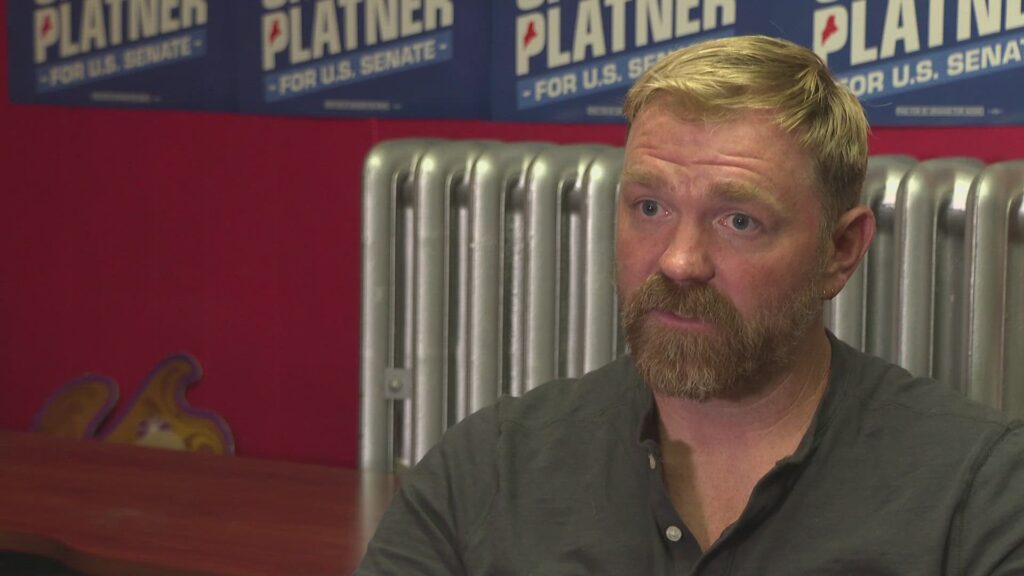
Platner has been billed as a “rising star” on the progressive left
Spending is already heavy and expected to grow. Through March 31, 2026, Collins had raised $13.2 million and held more than $10 million in cash on hand, augmented by tens of millions in outside-group advertising. Platner raised nearly $12 million and outspent both Collins and Mills on television ads in the first quarter. Total ad volume in the race has already exceeded records for a Maine Senate primary.
The contest will likely hinge on independent voters, who make up a large share of the electorate. Collins’s incumbency and moderate brand could retain enough crossover support to hold the seat. Platner’s path will likely rest on the national environment, in addition to swaying moderates and consolidating the Democratic Party base despite advancing progressive policies that have drawn criticism from some segments of the party
The Wolverine State will host another open Senate race in 2026 following the retirement of incumbent Senator Gary Peters, a Democrat who announced that he would not be seeking re-election last year. Former U.S. Rep. Mike Rogers, who narrowly lost to Democrat challenger Elissa Slotkin in 2024, is widely expected to once again clinch the Republican nomination in the August 4 primary contest. The former congressman has consolidated establishment support and benefits from a $45 million outside spending commitment by the Senate Leadership Fund.
The Democratic Party primary remains tightly contested three months before Election Day. U.S. Rep. Haley Stevens, state Sen. Mallory McMorrow, and former Wayne County health director Abdul El-Sayed are the leading candidates, with recent polling showing a fluid race with a sizable number of undecided voters. An April 2026 Emerson College poll had El-Sayed and McMorrow tied at 24 percent each and Stevens at 13 percent, while a late-April Glengariff survey showed Stevens at 25 percent, El-Sayed at 23 percent, and McMorrow at 16 percent.
Early general election polling also shows a competitive matchup regardless of the Democratic Party primary outcome. Hypothetical head-to-head surveys conducted in late 2025 and early 2026 have been scarce given the primary variables, though Rogers has enjoyed a number of early leads between three and six percentage points. A sizable number of voters remain undecided, however.
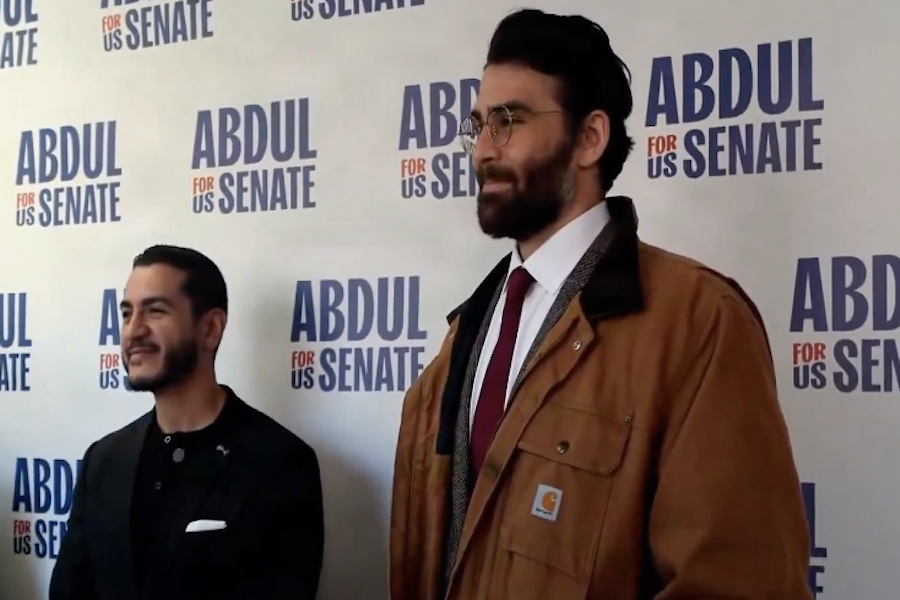
Michigan Democrat Abdul El-Sayed campaigns with far-left commentator Hassan Piker on April 7, 2026
El-Sayed’s progressive platform, which emphasizes issues such as abolishing ICE and healthcare coverage for noncitizens, could make the general election more competitive given the state’s historically competitive nature. An El-Sayed general election candidacy could potentially turn off moderate voters, though the progressive candidate has also enjoyed sizable polling advantages amongst younger Democrats.
All told, the primary winner will face a well-funded and experienced Republican in what is expected to remain one of the year’s most competitive Senate races.
In the Peach State, Democrats will be attempting to hold a seat in a state carried by President Trump in the 2024 presidential election. Incumbent Senator Jon Ossoff, who was first elected in a tightly-contested runoff election in 2021, is seeking his first full six-year term in the general election this November.
Ossoff holds a substantial fundraising advantage. He entered 2026 with approximately $25 million cash on hand. He has also continued to out-raise his potential opponents by significant margins, with recent filings indicating over $30 million available compared to far lower totals for leading Republicans.
On the Republican side, the May 19 primary contest failed to produce a winner in a crowded, largely three-person GOP field. Congressman Mike Collins received about 40.5 percent of the vote, followed by former University of Tennessee football coach Derek Dooley at 30.2 percent and Congressman Buddy Carter at 25.2 percent.
Collins and Dooley advanced to a June 16 runoff, which Collins secured on the heels of a late endorsement from President Trump.
Recent hypothetical general-election polling has generally shown Ossoff ahead or in close contests against the top Republicans. For example, early 2026 Emerson College surveys found Ossoff leading Collins 48 percent-43 percent, Carter 47 percent-44 percent, and Dooley 49 percent-41 percent.
Other surveys have reflected a much tighter race, however, with one poll from Quantus Insights finding Collins and Ossoff tied in a hypothetical general election matchup.
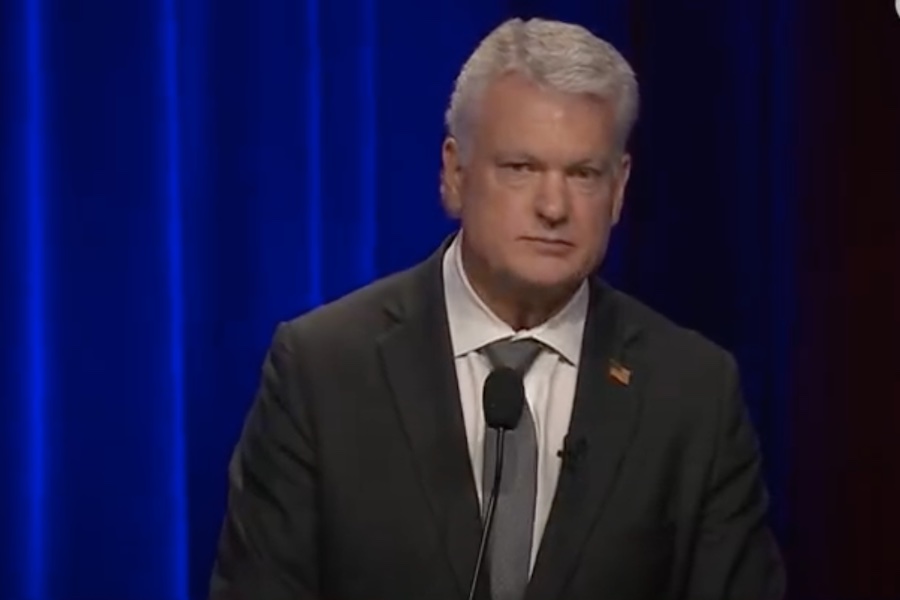
U.S. Rep. Mike Collins (R-GA) participates in a GOP Senate primary debate on May 31, 2026
Photo: C-Span
The race, as well as the fundraising disparity, is expected to tighten once the Republican primary wraps up. President Trump has not issued an endorsement in the race, reflecting the GOP preference to avoid costly primaries this cycle.
Trump won Georgia in 2024 by roughly 2.2 percentage points, when he received 50.7 percent of the vote to 48.5 percent for then-Vice President Kamala Harris. The state’s tight partisan lean and expected heavy spending on both sides will almost certainly ensure that Georgia is one of the most competitive Senate races in the 2026 midterm cycle.
In Alaska, the 2026 U.S. Senate race features a contest between incumbent Republican Senator Dan Sullivan and Democrat challenger Mary Peltola. This matchup has drawn national attention as one of the more competitive Senate races in a state that has leaned Republican in recent cycles.
Sullivan, who first won election to the Senate in 2014 by defeating incumbent Democrat Mark Begich, was re-elected in 2020. He previously served as Alaska’s attorney general and commissioner of the Department of Natural Resources.
Peltola, a former Alaska state representative, won Alaska’s at-large U.S. House seat in the 2022 special election and secured a full term later that year before losing re-election in 2024. Democrats are banking on a competitive race given Peltola’s popularity in the state and reputation as a moderate with demonstrated statewide appeal under Alaska’s ranked-choice voting system.
Recent polling reflects a close race. Multiple surveys from Alaska Survey Research in the first half of 2026 showed Peltola holding narrow leads, often in the 5- to 7-point range in head-to-head matchups. A New York Times/Siena poll conducted in mid-June found a consolidating race, however, with Sullivan ahead by two points, (47 percent to 45 percent).
Alaska Senate: who will advance?
Odds:
🟦 Mary Peltola: 98%
🟥 Dan S. Sullivan: 98%
🟥 Dan J. Sullivan: 57%
🟥 Dustin Darden: 57%
🟪 Sid Hill: 13%
🟥 Fred Grauberger: 13%
🟦 Carol Hafner: 13%
🟩 Richard Grayson: 11%
(All others under 5%) pic.twitter.com/oFzypddQBN— Kalshi Politics (@KalshiPolitics) June 30, 2026
Nonpartisan race ratings capture the uncertainty. The Cook Political Report rates the seat as Lean Republican, while Sabato’s Crystal Ball lists it as a toss-up. These assessments underscore the potential for the race to remain competitive through the August nonpartisan primary and the November general election, both conducted under Alaska’s top-four primary and ranked-choice voting rules.
Alaska has not elected a Democratic senator since Mark Begich’s narrow victory in 2008. Sullivan’s 2014 win over Begich began an uninterrupted period of Republican control of the state’s Senate delegation alongside Senator Lisa Murkowski. The current race tests whether Peltola can replicate her prior success in winning statewide office or if Sullivan can leverage his incumbency in a state that has trended Republican at the federal level in most recent cycles.
The Granite State will be the site of another open Senate election following the retirement of long-term incumbent incumbent Democrat Jeanne Shaheen, who will not be seeking a fourth term. Shaheen, first elected in 2008, announced her retirement in March 2025 after serving three terms.
While the primaries are scheduled for September 8, both parties have largely consolidated around preferred candidates. On the Democrat side, U.S. Rep. Chris Pappas is widely projected to be the nominee. In 2018, Pappas was elected to the U.S. House of Representatives for New Hampshire’s 1st congressional district and has been re-elected in each subsequent cycle.
The leading Republican candidate is former U.S. Senator John E. Sununu. Sununu first won election to the U.S. House of Representatives for New Hampshire’s 1st district in 1996, serving from 1997 to 2003. In 2002, he was elected to the U.S. Senate, where he served one term from 2003 to 2009 before losing re-election (to Shaheen) in 2008.
Pappas has maintained a sizable fundraising advantage as the early summer, having raised approximately $9.86 million and maintaining cash on hand of about $4.22 million. Other Democrat primary candidates reported significantly lower totals.
Republican candidates’ fundraising figures were more limited in publicly available early-cycle reports, though the general election is expected to attract substantial outside spending given the race’s competitive profile.
Polling in the hypothetical general election matchup between Pappas and Sununu has indicated a closely contested race. A March 2026 Emerson College poll found Pappas at 45% and Sununu at 44%, within the margin of error. Other surveys have shown single-digit leads for one candidate or the other, with the majority skewed towards Pappas.
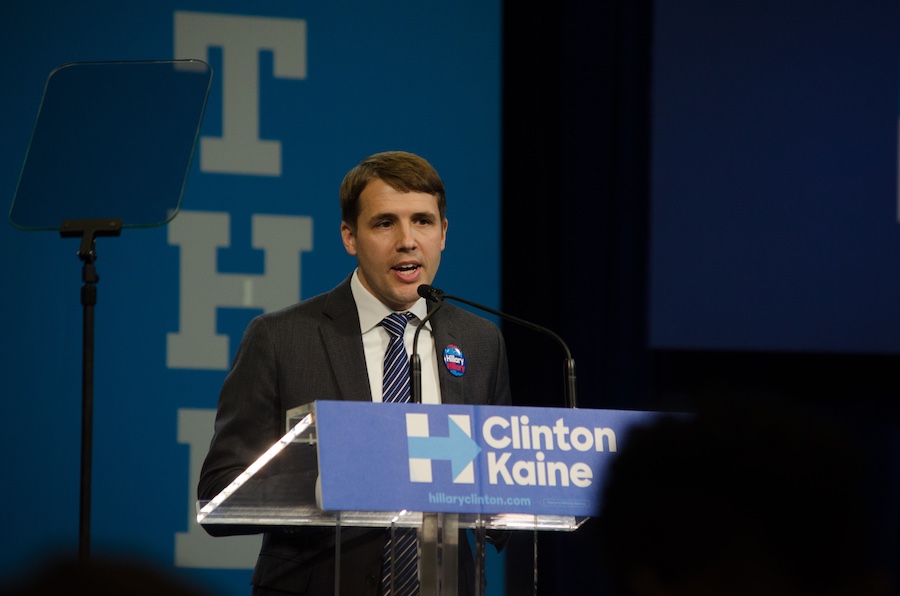
Chris Pappas, then a member of the New Hampshire Executive Board, speaks at a Hillary Clinton presidential rally at Southern New Hampshire University on October 13, 2016
Photo: Tim Pierce
New Hampshire has a history of producing narrow federal election outcomes, with Democrats winning by narrow margins in a number of recent presidential and midterm election cycles. Chris Sununu, brother of the former senator, won multiple terms as governor, and Republicans have periodically controlled the state legislature and executive council even as Democrats have held both U.S. House seats and the Senate delegation since 2017, however.
The state’s Cook Partisan Voting Index stands at D+2, reflecting the narrow split. Democrats will be hoping to capitalize on a typically favorable midterm environment to hold onto the seat, which has led most forecasters to favor a Democrat hold.
One of the more ambitious Democrat pick-up targets will come in Ohio, where incumbent Senator Jon Husted, a Republican, will be attempting to fend off a challenge from a familiar face in Democrat Sherrod Brown.
Husted, the state’s former lieutenant governor, was appointed Governor Mike DeWine in January 2025 following JD Vance’s election as Vice President. As for Brown, the three-term former senator will be looking to return to Washington just one cycle after he was defeated by Republican Bernie Moreno in 2024.
Democrats are banking on Brown’s name recognition to keep the race close. Brown’s decades of statewide elected service and prior Senate tenure have given him broad visibility among Ohio voters, which the party views as an asset in a contest that follows his 2024 defeat.
Republicans have been largely dominant in federal races in Ohio in recent cycles and hope to continue that trend, however. The state has supported Republican presidential candidates with expanding margins since 2016, and the party currently holds both U.S. Senate seats as well as a majority of the state’s U.S. House seats.
Republicans also maintain majorities in the Ohio General Assembly and control all statewide executive offices. Husted’s campaign builds on this pattern of Republican strength in federal contests, with the party emphasizing continuity in representation following the 2024 results.
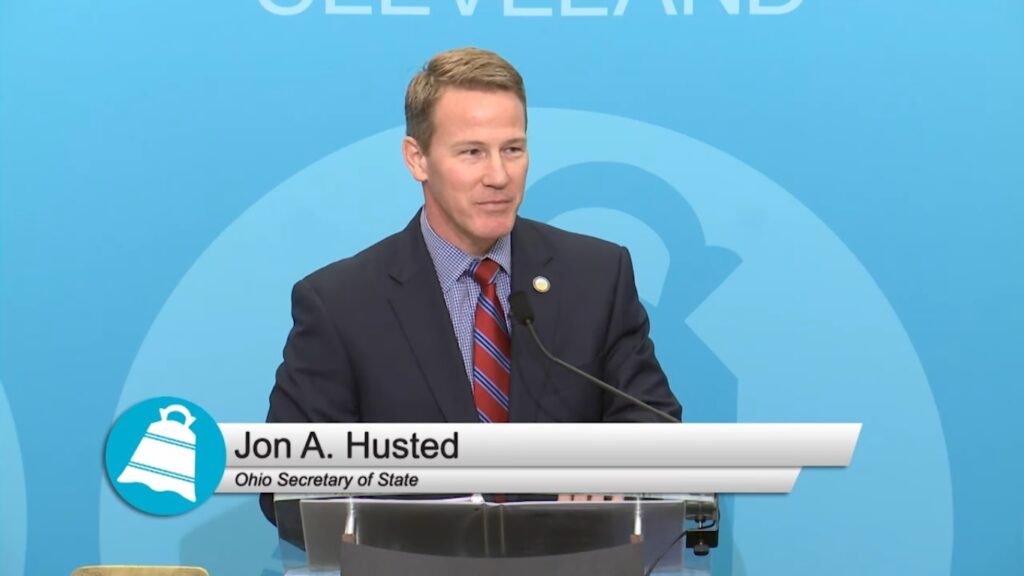
Husted during his time as Ohio Secretary of State
Ohio’s political environment reflects a broader realignment that has made the state more consistently supportive of Republican candidates in presidential and Senate elections over the past decade. Brown’s 2024 loss to Republican Bernie Moreno by approximately 3.6 percentage points marked the first time since 1954 that an incumbent Democratic senator was defeated in Ohio
While Brown’s name recognition and a close gubernatorial race could make Republicans sweat come November, the GOP has far outpaced Democrats in terms of fall ad buys, while national Republican PACs are expected to pour money into the race. Given the state’s partisan environment, Ohio remains a highly ambitious target that would likely require massive Democrat over-performance for a flip to occur.
Perhaps the most ambitious Democrat flip target will come in Texas, where the party will be hoping to induce a political earthquake by winning in the longtime Republican bastion.
The party has nominated James Talarico, a self-styled moderate who has leaned on his background as a Christian in hopes of appealing to the state’s electorate.
Talarico, a former middle school teacher and state lawmaker representing an Austin-area district, has been presented by supporters as someone positioned to appeal to independents and some Republican-leaning voters. Party-aligned efforts have directed substantial resources toward the campaign. As of June 2026, Talarico’s campaign had raised approximately $40.3 million, providing a notable financial advantage in the contest.
On the Republican side, state Attorney General Ken Paxton emerged victorious in a contentious primary contest against longtime incumbent John Cornyn earlier this year.
Outside groups supporting Cornyn spent tens of millions of dollars on his behalf and against challengers, including Paxton. Available figures indicate that pro-Cornyn forces outspent pro-Paxton efforts by a factor of roughly nine to one overall in the primary cycle, with spending margins remaining wide even in the runoff phase.
Despite this investment, Paxton secured the nomination with approximately 63.8 percent of the vote in the May 26 runoff.
New – Senate poll – Texas
🔵 Talarico 47%
🔴 Paxton 47%Siena #B – LV – 6/27 pic.twitter.com/rNKSHSzwFr
— Political Polls (@PpollingNumbers) June 30, 2026
As the general election has taken shape, Talarico has been the subject of relentless attack ads that have drawn national attention. The self-styled moderate has been attacked for saying that he “hates Christianity” despite presenting as one, expressing support for “trans kids” as a top priority, as well as past support for lax immigration enforcement and a number of additional topics.
The last Democrat senator elected from the state was Lloyd Bentsen in 1988. This partisan composition has shaped expectations in recent cycles.
In 2018, Democrat candidate Beto O’Rourke challenged incumbent Republican Ted Cruz during a national midterm environment in which Democrats made significant gains in the U.S. House. O’Rourke’s campaign raised approximately $70.2 million, substantially more than Cruz’s total of about $33.4 million when including affiliated entities.
Despite the fundraising disparity and heightened national attention, Cruz won reelection with 50.89 percent of the vote to O’Rourke’s 48.33 percent, a margin of roughly 2.6 percentage points.
While Democrats are banking on Talarico’s appeal to moderates and independents, his past support for leftist social agendas has weakened that approach. The party also trails in terms of national polling when compared with 2018, which should make a flip in Texas even more difficult, despite GOP establishment opposition to Paxton.