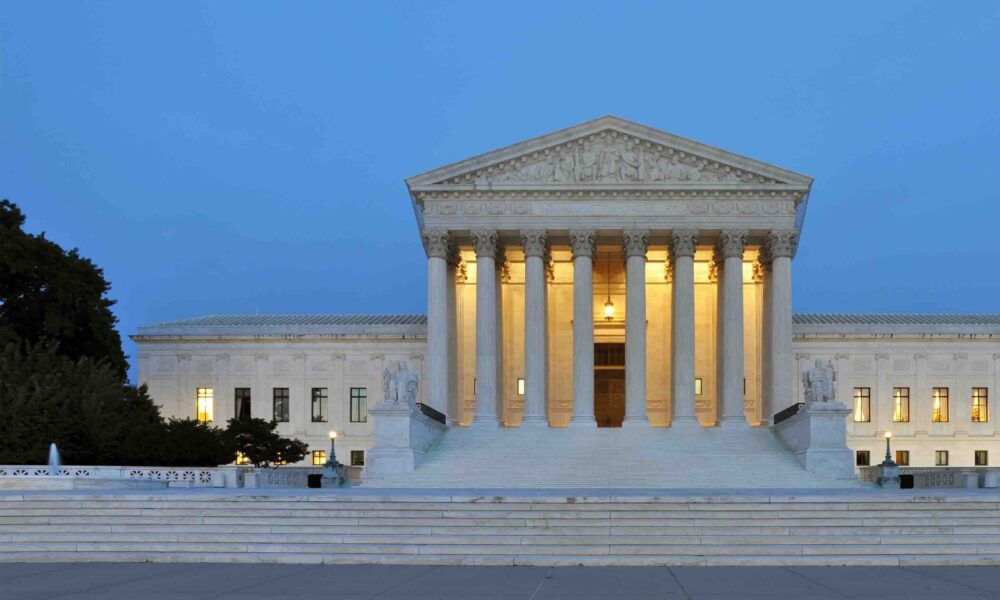

The Supreme Court unanimously ruled that Enbridge missed its chance to move Michigan’s Line 5 pipeline lawsuit from state court to federal court, and a judge cannot “toll” or pause the 30-day removal deadline to bail Enbridge out.
Here’s what happened, in plain English.
Michigan’s attorney general sued Enbridge in state court in 2019, arguing the company’s 1953 easement to run Line 5 under the Straits of Mackinac was invalid and that operating the pipeline was unlawful under Michigan law. Enbridge was served on July 12, 2019.
Federal law gives a defendant that’s sued in state court a limited window to remove the case to federal court. The key rule says the notice of removal “shall be filed within 30 days” after the defendant receives the complaint or is served, whichever comes first.
Enbridge did not remove the case in that 30-day window. Instead, it litigated in state court for more than a year.
Later, in 2020, Michigan’s governor separately tried to revoke the easement and filed a second lawsuit. Enbridge removed the governor’s case to federal court on time, and the parties essentially put the attorney general’s case on pause while the federal court addressed the governor’s case.
After the federal judge ruled there was federal-question jurisdiction in the governor’s case, the governor dismissed her lawsuit. Then Enbridge tried to remove the attorney general’s older case too. By then, Enbridge had waited 887 days.
The district court let Enbridge do it anyway, saying “equitable” principles justified excusing the late filing. The Sixth Circuit reversed and ordered the case sent back to state court.
The Supreme Court took the case to answer one question: can courts apply “equitable tolling” to extend the 30-day removal deadline?
The Supreme Court said no.
Justice Sonia Sotomayor wrote for a unanimous court that the statute’s text, structure and context show Congress did not want open-ended, case-by-case extensions. The court stressed that the 30-day deadline is nonjurisdictional, but that does not automatically make it flexible. Some deadlines are still mandatory even if they aren’t jurisdictional.
The biggest reason, Congress already wrote specific, detailed exceptions into the removal scheme. The court said an explicit list of exceptions is a strong sign courts should not invent additional equitable exceptions.
For example, the law has a built-in extension when a case “at first appears unremovable” but later it can be “ascertained that the case is” removable. Congress also created a “bad faith” exception in certain diversity cases, and other federal statutes explicitly allow time limits to be enlarged “for cause shown” in specific categories.
The court said those targeted carveouts would make little sense if judges could broadly toll the 30-day deadline whenever they thought it was fair. Bottom line, Enbridge’s removal was untimely, so the attorney general’s lawsuit must go back to Michigan state court.
Download the FREE Trending Politics App to get the latest news FIRST >>