
The Supreme Court on Wednesday narrowed how courts can use a key part of the Voting Rights Act, a decision that civil rights groups warned could reshape redistricting fights across the South and beyond.
The case, Louisiana v. Callais, centered on Louisiana’s congressional map and whether state lawmakers were improperly forced to draw districts based on race. In a ruling that leaves Section 2 of the Voting Rights Act on the books but makes it harder to use in map challenges, the court said Louisiana was not required under the law to create an additional majority-minority district.
In the majority opinion, Justice Samuel Alito wrote that “because the Voting Rights Act did not require Louisiana to create an additional majority-minority district, no compelling interest justified the State’s use of race in creating SB8, and that map is an unconstitutional racial gerrymander.”
The practical impact is big. Section 2 has long been the main tool for challenging maps that dilute minority voting strength. The ruling tightens the standards lower courts must apply and gives states more room to argue that partisan considerations, not race, drove their lines, insulating maps from Voting Rights Act claims.
Supporters of the decision say it reins in a legal regime that, in their view, pressured states to use race in a way that conflicts with the Constitution’s equal protection guarantees. Critics say it effectively weakens a central voting rights safeguard by making it easier for lawmakers to defend maps as “politics” even when minority voters argue they are being boxed out.
Louisiana has been in court over its congressional lines since the last round of redistricting. Black residents make up roughly 30% of the state’s population. In 2022, Black voters and allied groups successfully sued, arguing the map left them underrepresented and should include a second majority-Black district. Louisiana lawmakers revised the map, and then a separate group of voters who described themselves as “non-African Americans” sued, claiming the revised plan relied too heavily on race.
A three-judge panel agreed with that challenge in 2024, setting the stage for the Supreme Court’s intervention.
Alito framed the decision as a warning that lower courts have stretched Section 2 in a way that can compel race-based decision-making. “Section 2 of the Voting Rights Act of 1965 was designed to enforce the Constitution — not collide with it,” he wrote.
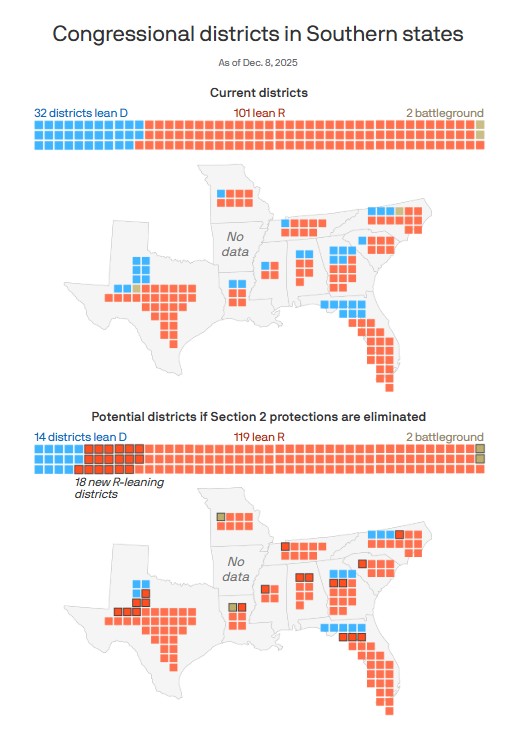
Screenshot-Axios.
“Unfortunately, lower courts have sometimes applied this Court’s §2 precedents in a way that forces States to engage in the very race-based discrimination that the Constitution forbids.”
Outside analysts and advocacy groups immediately argued the ruling could have ripple effects beyond Louisiana, especially in the South, where most of the major redistricting fights over minority representation have played out for decades.
April Albright of Black Voters Matter previously described Section 2 as a backstop against aggressive mapmaking. The Voting Rights Act “was the guardrail,” she told Axios, warning that without it “there’s nothing left, because most of these red states also don’t have robust protections for voting rights in their own state constitutions.”
Black Voters Matter has also modeled potential political fallout if Section 2 challenges become harder to win, arguing Republicans could end up with a significant advantage over 2024-era maps. The group estimated Republicans could secure more seats, including at least 19 tied directly to weakened Section 2 enforcement. Those projections are not court findings, but they underscore how both parties are already gaming out the next map wars.
The ruling also lands as Republican-led states eye mid-decade redistricting, a tactic that can move faster than the usual once-a-decade process. Florida Gov. Ron DeSantis, for example, has faced scrutiny over a separate push to revisit congressional lines before the next census cycle. A narrower Section 2 framework could affect how those disputes unfold in court.
Louisiana Rep. Troy Carter, a Democrat who represents one of the state’s majority-Black districts, warned the decision invites a political arms race. “It defies our rule of law,” he told Axios New Orleans.
“Every time we have a change in the White House, are we going to go back and, likewise, change the demographics of our congressional seats? It’s not what the framers of the Constitution intended.”
With the court now signaling that partisan goals can weigh more heavily in these disputes, both parties are expected to test how far states can push map changes before the 2026 midterms.
Download the FREE Trending Politics App to get the latest news FIRST >>