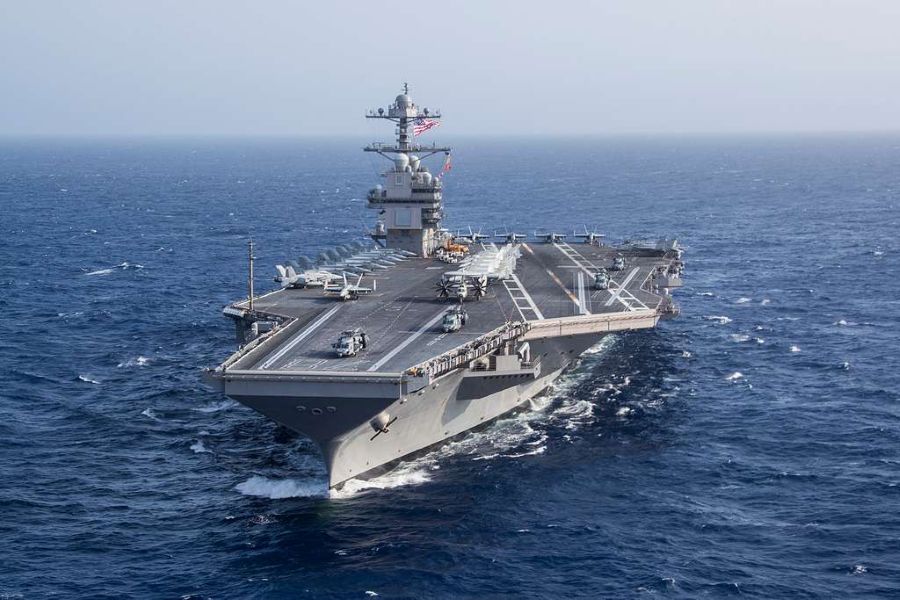

The USS Gerald Ford, which is the largest aircraft carrier in the U.S. Navy, returned to Naval Station Norfolk, Virginia, on Saturday after completing a 326-day deployment that set a post-Vietnam War record for the longest U.S. aircraft carrier deployment.
The ship, along with elements of Carrier Strike Group 12, had departed Norfolk on June 24, 2025, for what was initially planned as a routine seven-month deployment to the U.S. European Command area.
Approximately 4,500 sailors and personnel were aboard during the extended period at sea. Families gathered at the pier for reunions, with reports noting that around 80 children born during the deployment met their fathers for the first time
“While I cannot begin to count the number of birthdays, anniversaries, holidays, and milestones missed during this deployment, I can say this with absolute certainty: The sacrifice of our families is inseparable from the success of this carrier strike group,” Rear Admiral Gavin Duff, commander of Carrier Strike Group 12, said shortly after the ship’s arrival.
Defense Secretary Pete Hegseth attended the homecoming and presented the Presidential Unit Citation to the strike group. This award recognizes extraordinary heroism in combat. “The Ford Carrier Strike Group did an extraordinary job. The only story we can tell today is of the heroism and the skill and the professionalism of these sailors, who went three times around the globe to defend that flag right there,” Hegseth said.
“You didn’t just accomplish a mission, you made history. You made a nation proud,” the secretary added.
The historic deployment involved operations across three combatant commands: U.S. European Command, U.S. Southern Command, and U.S. Central Command. It began in the Mediterranean Sea, where the strike group participated in NATO exercises, including operations in the Ionian and Adriatic seas and the High North region.
In October 2025, the Ford was redirected to the Caribbean as part of a naval buildup supporting counter-drug and regional stability efforts. The strike group later participated in the operation that led to the capture of Venezuelan dictator Nicolas Maduro.
The strike group then transited back across the Atlantic to the Mediterranean and, in early 2026, moved through the Suez Canal to the Red Sea to support Operation Epic Fury against Iran in the U.S. Central Command area. This involved joint operations with other carriers, including the USS George W. Bush and USS Abraham Lincoln, which marked the first time in over two decades that three U.S. carriers operated simultaneously in the Middle East.
In March 2026, a fire occurred in the ship’s main laundry spaces while operating in the Red Sea. The fire was contained, but it affected berthing compartments and displaced about 600 sailors. Three sailors were injured, with one medically evacuated.
The carrier subsequently docked at Naval Support Activity Souda Bay in Crete for repairs and maintenance before resuming operations and later returning via the Atlantic.
“We thought it would be a seven-month deployment. These were missed events from weddings to births,” Chief of Naval Operations Admiral Daryl Caudle said of the record-breaking deployment. The previous post-Vietnam record was 295 days, set by the USS Abraham Lincoln in 2020. The Ford surpassed that mark on April 15, 2026.
Escorting destroyers USS Bainbridge and USS Mahan returned with the carrier. Other ships in the group included USS Mitscher, USS Forrest Sherman, and USS Winston S. Churchill.