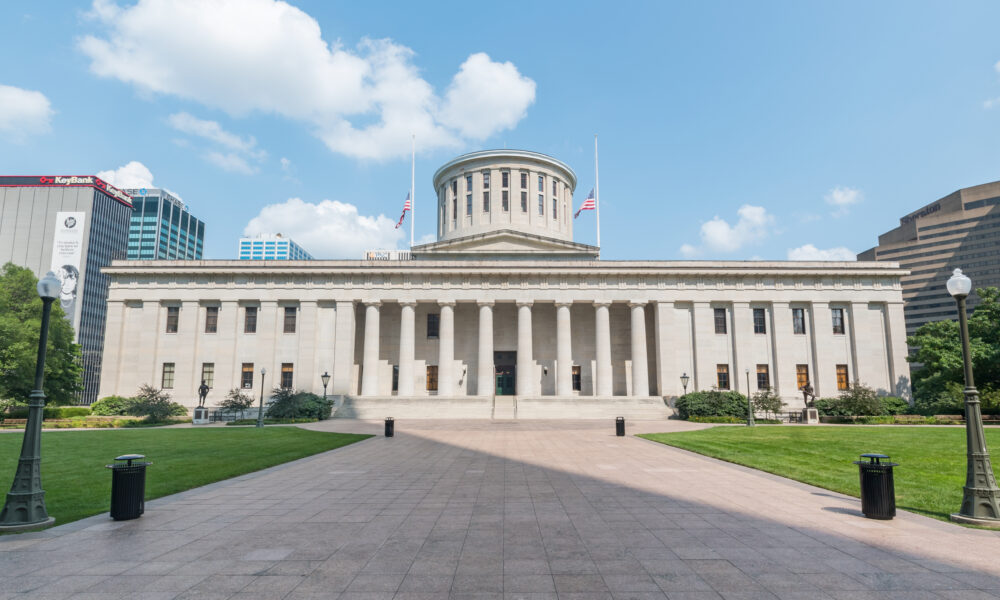

Ohio Gov. Mike DeWine vetoed a Republican-backed election bill that would have required absentee voters to include a copy of their photo ID with their ballots, rejecting a measure supporters framed as an added layer of election security.
The governor’s office announced Wednesday night that DeWine signed several bills into law but vetoed House Bill 472 and House Bill 173.
HB 472, sponsored by state Rep. Jodi Salvo, R-Bolivar, would have required Ohioans voting absentee to include a copy of their photo identification with their ballot starting in 2027.
DeWine said the measure would create a new burden for voters who cast ballots by mail and argued it would not meaningfully improve election security.
The Republican governor said Ohio already has a strong election system that is widely considered one of the most secure and well-run in the country.
“While on paper one can make the case that there is a pathway for absentee voters to overcome the hurdles to voting that this bill creates, if the net result is that a number of voters will be deterred from making the attempt to vote, that result is hurtful, not helpful — to our efforts to include all of our citizens in the most basic act that involves them in our democratic process,” DeWine wrote. “The provision in H.B. 472 that allows for online absentee ballot applications is much needed, and I commend the Legislature for passing it. It is unfortunate that it is in a bill that I must veto.”
The veto is likely to frustrate election-integrity conservatives who have pushed for stricter voting rules after years of national fights over mail ballots, voter ID and public confidence in elections.
DeWine also vetoed HB 173, a bill sponsored by state Rep. David Thomas, R-Jefferson, dealing with submetered utility services.
“The Supreme Court of Ohio has recently held that submetering companies, which buy and resell electricity at a profit, are public utilities regulated by the Public Utilities Commission of Ohio. Substitute House Bill 173 would exempt submetering companies from the definition of a public utility, although the Public Utilities Commission would still retain oversight authority,” DeWine said, in part, regarding his veto decision. “However, while this bill does contain some consumer protections, they are not as robust as those afforded to customers of Ohio’s electric utilities.”
🚨 BREAKING: Ohio Gov. Mike DeWine is facing mass outrage nationwide for VETOING legislation that would require photo ID to vote by mail
UNREAL!! How can a REPUBLICAN governor oppose this?
DeWine says it’s a “burden” 🤯
Every state needs to fortify their elections, STOP… pic.twitter.com/nBbKM8wljP
— Eric Daugherty (@EricLDaugh) June 25, 2026
Along with the vetoes, DeWine signed a slate of other measures into law.
Senate Bill 19, sponsored by state Sen. Andrew O. Brenner, R-Delaware, deals with academic intervention services at public schools, approved diagnostic assessments, state achievement assessments, career-technical education for home-educated students, youth organization presentations and community school quality designations.
Senate Bill 52, sponsored by state Sen. Tim Schaffer, R-Lancaster, designates several memorial highways, including the “Congressman David Hobson Memorial Highway,” and creates multiple specialty license plates.
Senate Bill 106, sponsored by state Sen. Bill Reineke, R-Tiffin, addresses electric vehicle charging stations and makes corrections to provisions of Senate Bill 103 from the 136th General Assembly.
Senate Bill 179, sponsored by state Sen. Terry Johnson, R-McDermott, requires incarcerating institutions to verify the veteran status of incarcerated individuals.
Senate Bill 219, sponsored by state Sen. Al Landis, R-Dover, makes changes to Ohio law governing oil and gas wells.
House Bill 170, sponsored by state Reps. Monica Robb Blasdel, R-New Waterford, and Bob Peterson, R-Sabrina, creates a process to regulate carbon capture and storage technologies and the geologic sequestration of carbon dioxide for long-term storage.
House Bill 268, sponsored by state Reps. Latyna M. Humphrey, D-Columbus, and Gary Click, R-Vickery, modifies when a person may file a petition for a certificate of qualification for employment.
DeWine also signed House Bill 479, sponsored by state Rep. Jean Schmidt, R-Loveland, but issued a line-item veto.
The bill makes appropriations and provides authorization and conditions for the operation of state programs.
DeWine said the line-item veto was aimed at preserving funding for outdoor recreation development in Appalachia.
This item would terminate previously appropriated funding to the Outdoor Recreation Council of Appalachia. This funding termination would disrupt economic development related to the Baileys Trail System that is already in progress. In my time as Governor, I have worked to foster the economic development of Ohio’s outdoor recreation sector, and this item would unnecessarily harm this development in the Appalachian region of Ohio. Therefore, the veto of this item is in the public interest.
The voter ID veto is the headline-grabber, giving DeWine another clash with conservatives who believe absentee voting should come with tougher safeguards.
For DeWine, the bill went too far by risking voter participation without adding enough security.
For MAGA-aligned election hawks, it will likely look like a red-state governor blocking a common-sense voter ID rule at the worst possible time.