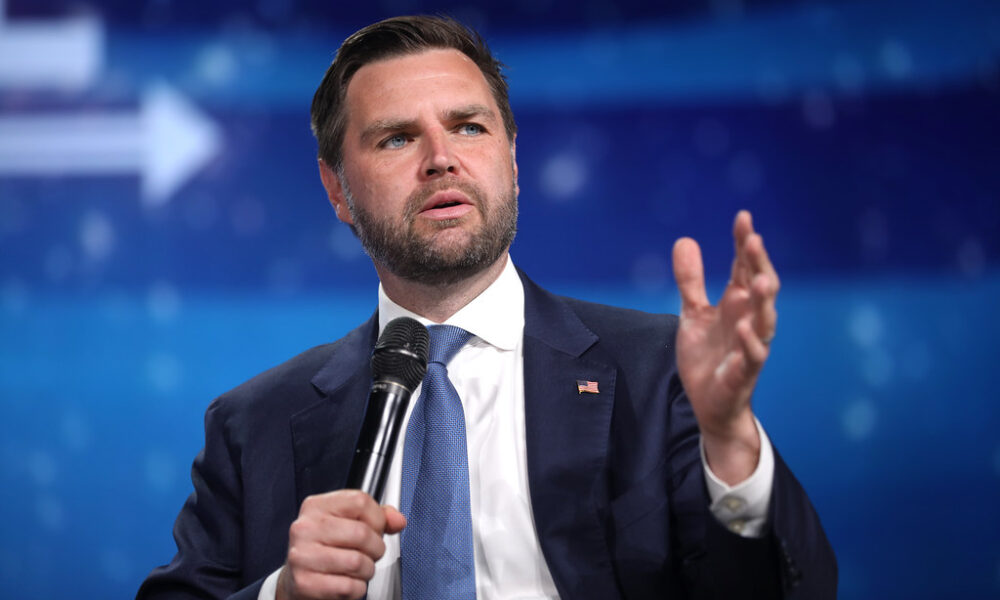

Vice President JD Vance issued a firm warning to the Iranian regime after a commercial ship was fired upon in the Strait of Hormuz on Thursday evening. The violation led to retaliatory strikes on regime targets near the strait.
U.S. Central Command (CENTCOM) confirmed that the strikes were launched in response to Iranian attacks targeting the Singapore-flagged cargo vessel M/V Ever Lovely. CENTCOM stated that the strikes targeted Iranian missile and drone storage sites and coastal radar sites.
In its announcement, CENTCOM described the action as “a powerful response to yesterday’s attack on a commercial ship that was transiting the Strait of Hormuz” and noted it addressed “unwarranted aggression against commercial shipping by Iranian forces” that “clearly violated the ceasefire.”
U.S. forces indicated they would continue providing safe passage coordination and support to commercial vessels in the area, regardless of Iranian actions.
Vice President JD Vance responded directly to Thursday’s actions in a social media post. “Iran signed a ceasefire agreement. We have honored it. If they have disagreements about how the MOU is being applied, they can pick up the phone, but violence will be met with violence,” the vice president wrote.
Iran signed a ceasefire agreement. We have honored it. If they have disagreements about how the MOU is being applied, they can pick up the phone.
But violence will be met with violence. https://t.co/VWnBS1PWaV
— JD Vance (@JDVance) June 26, 2026
The strikes took place against the backdrop of ongoing peace talks between the United States and Iran, which escalated significantly following the signing of a memorandum of understanding (MOU) between the two sides earlier this month.
Third-party mediators have described recent discussions, including last week’s meeting in Switzerland, as substantive. Those talks produced a roadmap toward a final deal within 60 days, covering issues such as Iran’s nuclear program, sanctions, and mechanisms for de-escalation in areas like the Strait of Hormuz and Lebanon.
The framework built on the June 17 MOU that established a ceasefire and set the stage for further negotiations, with both sides expressing interest in stabilizing the region through diplomatic channels despite periodic tensions.
The situation in the Strait of Hormuz remains a key focus, given its importance to global energy markets. U.S. and international partners have supported alternative coordination for safe passage, despite continued Iranian threats and an expressed desire to charge tolls for passage through through the vital waterway, which accounted for roughy 20 percent of global oil exports prior to the start of the conflict in late February.
The Trump Administration has stated that any Iranian effort to charge tolls will not be tolerated.