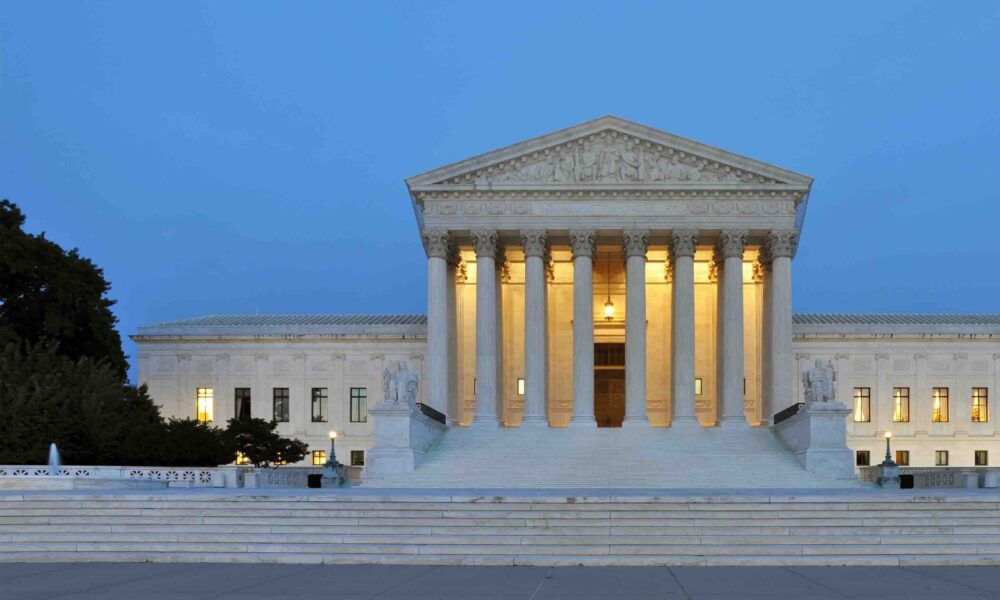

The Supreme Court handed President Donald Trump a sweeping victory Monday, ruling that he had the constitutional authority to fire Democratic Federal Trade Commissioner Rebecca Slaughter and formally wiping out a 91-year-old precedent that shielded some independent agency officials from direct White House control.
In a 6-3 decision along ideological lines, the high court strengthened presidential power over the executive branch and dealt a major blow to the long-standing independence of federal regulatory agencies.
The ruling overturns the court’s 1935 landmark decision in Humphrey’s Executor v. United States, which had allowed Congress to protect certain executive branch officials from being fired by the president except for cause.
“If anything more is left of Humphrey’s, we overrule it,” Chief Justice John Roberts wrote for the majority.
The decision gives Trump the right to remove Slaughter, a Democratic appointee who became the central figure in his push to tear down limits on presidential removal power.
Beyond the FTC, the ruling could affect roughly two dozen multimember agencies across the federal government.
Those agencies regulate wide areas of American life, including labor disputes, federal employee rights, workplace discrimination, credit unions, product recalls and plane accidents.
Legal conservatives had long argued that the old precedent violated the separation of powers by allowing officials inside the executive branch to operate without meaningful accountability to the elected president.
The court’s conservative majority had already narrowed Humphrey’s Executor in several recent rulings before Monday’s decision finished the job.
After returning to the White House, Trump fired several heads of independent agencies despite statutory protections that were supposed to limit a president’s ability to remove them.
Those officials largely prevailed in lower courts, where judges were bound by the 1935 precedent.
But the Supreme Court can overrule its own prior decisions, and on Monday it did exactly that.
The case brought the fight back to the same agency at the center of the original 1935 ruling.
In Humphrey’s Executor, the Supreme Court held that Congress could restrict the president from firing heads of certain agencies that exercised “quasi-judicial” and “quasi-legislative” functions.
That decision blocked then-President Franklin D. Roosevelt from firing an FTC commissioner who did not support his New Deal agenda.
For decades, Congress has barred presidents from firing FTC commissioners except for “inefficiency, neglect of duty or malfeasance in office.”
Trump did not cite any of those reasons when he removed Slaughter.
Instead, he said keeping her in the role would be “inconsistent with my Administration’s priorities.”
Slaughter had first been appointed by Donald Trump to a Democratic seat on the commission in 2018.
Former President Joe Biden later renominated her for a new term set to expire in 2029.
The ruling marks a major shift in how independent agencies answer to the White House.
For Trump and his allies, it is a victory for direct presidential accountability and a rejection of an unelected bureaucracy operating beyond the reach of voters.
POLL: Ilhan Omar Now Claims She’s Broke – Do You Believe Her?