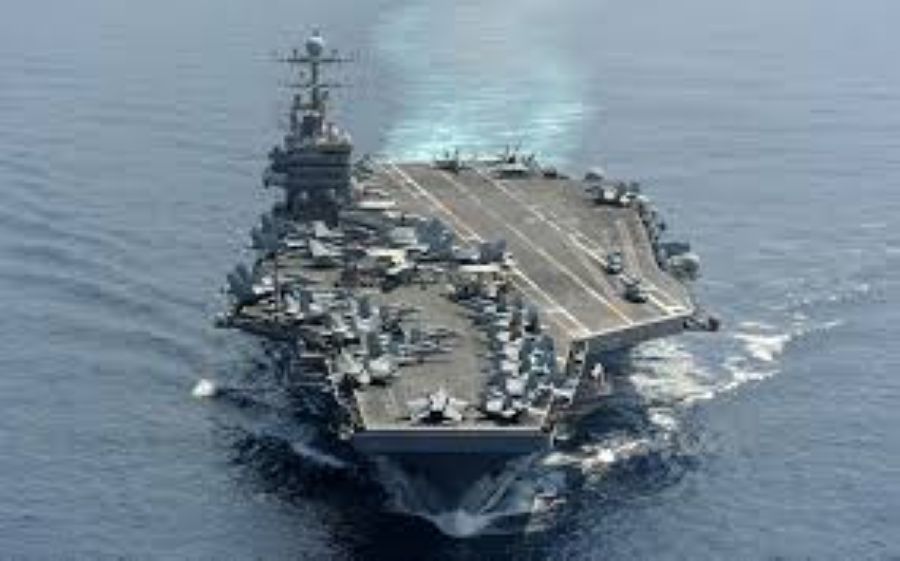

The United States has repositioned two aircraft carrier strike groups into the Gulf of Oman, accompanied by more than 20 U.S. Navy warships operating across Middle East waters, according to maritime tracking data. The repositioning comes as President Donald Trump has indicated that he is open to reimposing a blockade on Iranian ports following a recent flare-up of hostilities.
Maritime tracking data indicates that the the USS Abraham Lincoln and USS George H.W. Bush carrier strike groups have entered the area in recent days.
U.S. Central Command stated on July 8 that more than 20 Navy warships are patrolling regional waters to promote security and stability. The command declined further comment on specific operational plans, citing security considerations.
The recent naval movements follow a flare-up of hostilities earlier this month, which marked the most significant U.S. military operations in the region since a fragile ceasefire was agreed to this past April. U.S. trikes occurred after Iran attacked multiple commercial vessels in the Strait of Hormuz between July 5-6, a blatant violation of the ceasefire and subsequent Islamabad memorandum.
In response, U.S. forces struck more than 80 Iranian targets, including air defense systems, command and control networks, coastal radar sites, anti-ship missile capabilities, and over 60 Islamic Revolutionary Guard Corps small boats near the strait. The United States also revoked waivers allowing Iranian oil sales and reimposed related sanctions.
While speaking at the NATO Leaders’ Summit following the strikes, President Trump stated that the interim ceasefire agreement was over. He described further dealings with Iran as unproductive while indicating that the United States had agreed to continue talks following a request from Iran.
JUST IN:
US aircraft carrier USS Abraham Lincoln was spotted sailing north through the Gulf of Oman, operating within range of Iranian missiles.
No escort warships were visible alongside the carrier. pic.twitter.com/yURtj3k1nB
— Current Report (@Currentreport1) July 10, 2026
The Trump administration is also considering reinstatement of a naval blockade on Iranian ports, a measure previously implemented earlier this year that had affected Iranian economic activity. Retired Rear Adm. Mark Montgomery, senior fellow at the Foundation for Defense of Democracies, noted that naval assets typically move closer to operational areas when preparing for blockade enforcement or support of commercial transits through the Strait of Hormuz.
Despite mounting escalation, President Trump indicated that talks are continuing with the Iranian delegation after they requested to do so. A Qatari delegation concluded talks in Tehran on July 10 aimed at de-escalating tensions, conducted in coordination with the United States. Iranian officials, including Foreign Minister Abbas Araghchi, traveled to Oman on July 11 for discussions on arrangements for safe navigation through the Strait of Hormuz and related bilateral matters.
U.S. officials have emphasized the importance of Iran committing to cease attacks on commercial shipping and ensuring open transit lanes through the strait.