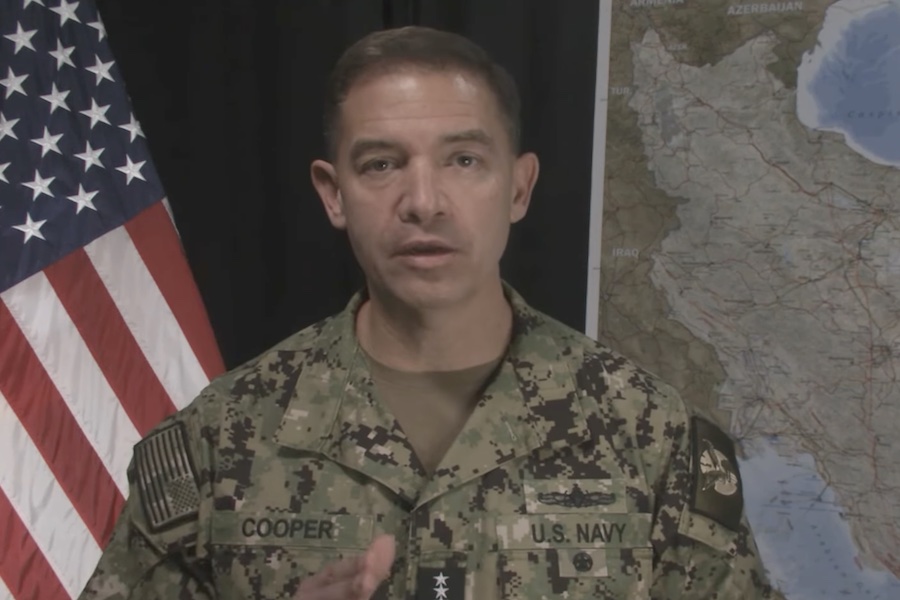

U.S. Central Command has issued statements rejecting recent Iranian assertions about authority over the Strait of Hormuz following an attack on a commercial vessel and subsequent U.S. military strikes on Iranian targets.
On Saturday, July 11, Iranian forces attacked the Cyprus-flagged container ship M/V GFS Galaxy while it was transiting the Strait of Hormuz. According to CENTCOM, the vessel sustained significant engine room damage and an onboard fire, rendering it unable to continue its journey.
One civilian crew member, an Indian national, was reported missing following the attack.
In response to the aggression, U.S. forces launched a third round of strikes this week against Iranian targets. The strikes, conducted at the direction of the Commander in Chief, targeted Islamic Revolutionary Guard Corps (IRGC) positions, missile systems, air defenses, fast-attack boats, radars, and related facilities on Qeshm Island and areas near Bandar Abbas.
CENTCOM described the action as intended to impose costs on Iran for attacks on commercial shipping and to degrade its capacity to threaten vessels in the international waterway.
Iranian authorities responded by declaring restrictions or closure of the Strait of Hormuz. The ruling Iranian Revolutionary Guard Corps (IRGC) claimed the waterway was closed to vessel traffic, with references to vessels using unauthorized routes and requirements for identification, tracking, and monitoring by Iranian forces.
Iranian state media and military communications have framed these measures in the context of broader regional tensions and prior incidents involving commercial shipping.
On Sunday morning, CENTCOM responded by refuting the claim and stating that the strait remains open to commercial vessels.
“CLAIM: The Iranian commander for the Islamic Revolutionary Guard Corps-Navy recently said on state-owned media that no foreign vessels may pass through the Strait of Hormuz without being identified, tracked, and monitored by Iranian forces. FACT: Iran does not control the Strait of Hormuz. It remains an international waterway. U.S. forces are positioned and prepared to keep it that way,” CENTCOM posted on social media.
🚫 CLAIM: The Iranian commander for the Islamic Revolutionary Guard Corps-Navy recently said on state-owned media that no foreign vessels may pass through the Strait of Hormuz without being identified, tracked, and monitored by Iranian forces.
✅ FACT: Iran does not control the… pic.twitter.com/8lRDNiOpXQ
— U.S. Central Command (@CENTCOM) July 12, 2026
“The Strait of Hormuz is open to all vessels seeking to lawfully transit the international waterway. U.S. forces are positioned and prepared to ensure that freedom of navigation remains available despite unwarranted Iranian aggression, harassment, threats, and arbitrary declarations. Iran does not control the strait. Traffic is flowing,” a follow-up statement reads.
CENTCOM has also referenced prior facilitation of commercial traffic. One earlier statement noted that since early May, U.S. forces helped facilitate the successful transit of more than 800 commercial vessels and 380 million barrels of crude oil through the vital international trade corridor, while rejecting claims of Iranian control over designated routes.
As of the most recent CENTCOM updates, the command maintains that the waterway remains open for lawful transit and that U.S. forces are active in the area to uphold freedom of navigation. No independent verification of complete closure or full Iranian control has been reported in these statements.