
Iran is ramping up threats just days before a fragile ceasefire with the United States is set to run out.
Iranian Parliament Speaker Mohammad Bagher Ghalibaf warned Monday that Tehran is ready to escalate, signaling possible new military action if talks collapse.
“Trump, by imposing a siege and violating the ceasefire, seeks to turn this negotiating table — in his own imagination — into a table of surrender or to justify renewed warmongering,” Ghalibaf wrote on X.
“We do not accept negotiations under the shadow of threats, and in the past two weeks, we have prepared to reveal new cards on the battlefield,” he concluded.
The warning lands as a two-week ceasefire, brokered by Pakistan and announced on April 8, is set to expire on Wednesday. Ghalibaf previously led Iran’s delegation during the April 11 talks in Islamabad with a U.S. team headed by Vice President JD Vance.
Vance is expected to return to Pakistan on Tuesday for another round of negotiations ahead of the deadline, according to PBS.
But Tehran is already signaling it may not play ball.
Iranian officials have taken a harder line in recent days, including reversing course on the Strait of Hormuz, one of the world’s most critical shipping lanes. After initially indicating the waterway would remain open, Iran’s military announced over the weekend it had reimposed strict controls.
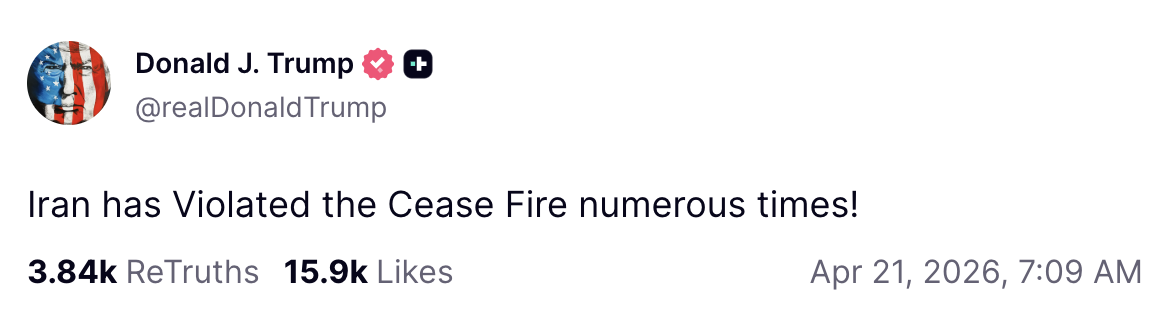
President Donald Trump pushed back, declaring the Strait was “COMPLETELY OPEN” in a Friday Truth Social post while making clear U.S. pressure would continue.
“Until there is a ‘DEAL,’” Trump wrote, referring to the ongoing blockade targeting Iranian-linked shipping.
Iran’s joint military command responded a day later, saying “control of the Strait of Hormuz has returned to its previous state… under strict management and control of the armed forces,” and warned restrictions would remain in place as long as the U.S. blockade continues.
Meanwhile, Iranian leadership is casting doubt on whether talks will even happen.
Foreign Ministry spokesman Esmaeil Baqaei said Monday that Tehran has no intention of negotiating under pressure and may skip the Islamabad meeting altogether.
“If the U.S. sends a team to Islamabad, that is a matter that concerns them,” Baqaei said in a press conference.
“The Islamic Republic of Iran does not accept any deadlines or ultimatums to safeguard its national interests. We have clearly stated our red lines from the beginning, and we will not change our principled positions,” he added.
With the clock ticking toward Wednesday’s deadline, both sides appear dug in — raising the risk that the brief pause in fighting could soon give way to another round of confrontation.
Download the FREE Trending Politics App to get the latest news FIRST >>