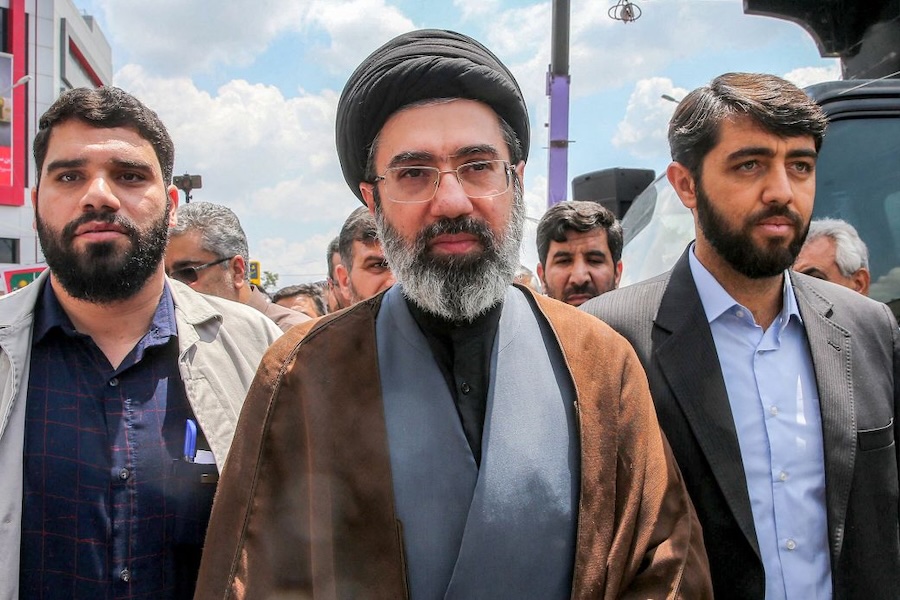

Iran’s Supreme Leader Mojtaba Khamenei is reportedly recovering from severe wartime injuries that may have left him needing a prosthetic leg, according to multiple reports that have fueled new questions about who is truly running Iran.
Claims surrounding Khamenei’s health trace back to the February 28 strike that reportedly killed his father, former Supreme Leader Ali Khamenei, along with several relatives. Since assuming power in March, Mojtaba Khamenei has remained almost entirely out of public view, intensifying speculation over both his physical condition and his ability to govern during a volatile period.
According to Iranian officials familiar with the matter who spoke to The New York Times, one of Khamenei’s legs has undergone three surgeries and is now expected to require a prosthetic. The report also says he suffered injuries to one hand, along with serious burns to his face and lips that have made speaking difficult.
Those injuries are reportedly significant enough that plastic surgery may be required before he can comfortably appear in public or deliver televised remarks. To date, Khamenei has not issued any known public video or audio statements since taking power, relying instead on written messages.
The report paints a picture of an Iranian leadership structure that has shifted dramatically since the death of Ali Khamenei. While Mojtaba Khamenei was selected as supreme leader in March, he reportedly does not command the same centralized authority his father held for decades.
Instead, real influence is said to be concentrated among senior commanders within the Islamic Revolutionary Guard Corps, commonly known as the IRGC. The military body has long been one of the most powerful institutions inside Iran, but analysts now say its role has expanded even further.
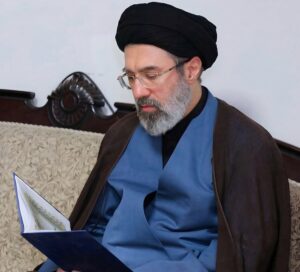
Tehran, Iran – May 2022: Mojtaba Khamenei, son of Iran’s Supreme Leader Ayatollah Ali Khamenei, is seen reading a book in an indoor setting.
Among those reportedly shaping major decisions are Ahmad Vahidi, Mohammad Bagher Zolghadr, and Yahya Rahim Safavi. They are described as taking the lead on war strategy, diplomacy, and national security matters while the supreme leader recovers.
Sourcces claim the Guards were central to several wartime decisions, including strikes against Israel, closure of the Strait of Hormuz, and ceasefire talks involving the United States. It also says civilian officials, including President Masoud Pezeshkian and Foreign Minister Abbas Araghchi, were sidelined during key negotiations.
Security concerns around Khamenei’s location appear to be extreme. Messages to him are reportedly being delivered through trusted couriers traveling by car or motorcycle, while senior officials avoid visiting him out of fear their movements could be tracked by Israeli intelligence.
That has added to the perception that Iran is currently operating less as a clerical hierarchy and more as a military command structure.
The absence of public appearances has become one of the biggest political stories inside and outside Iran. Traditionally, the supreme leader is seen as the country’s ultimate authority over military, religious, and state matters. With Mojtaba Khamenei reportedly unable to appear publicly, many observers believe power is shifting elsewhere.
Iran has not broadly confirmed many of the specific medical claims, and wartime reporting on leadership conditions can be difficult to independently verify. Still, the continued silence, combined with reports of serious injuries, has only increased uncertainty.
The timing is especially sensitive. Iran remains engaged in tense negotiations over ceasefire terms, shipping lanes, and regional military pressure. If the nation’s top leader is unable to fully function, the consequences could extend far beyond Tehran.