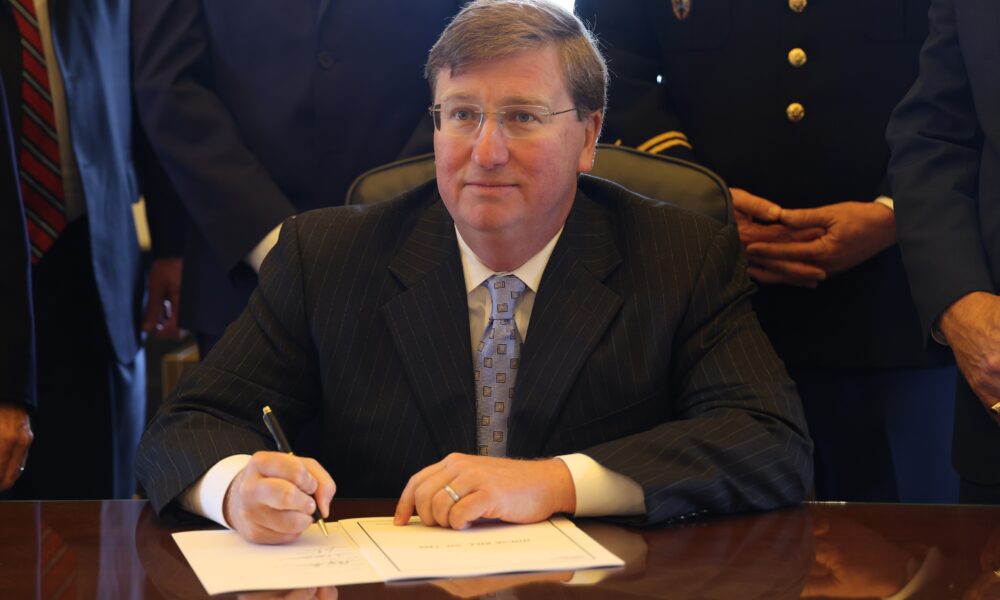

Mississippi Governor Tate Reeves announced on April 24, 2026, that he will call the state legislature into a special session to redraw the three judicial districts used to elect Mississippi Supreme Court justices. The session will convene 21 calendar days after the U.S. Supreme Court issues its decision in Louisiana v. Callais, a pending case that could have massive implications on the Voting Rights Act and race-based congressional districts.
“During the recently completed regular session, the Legislature discussed drawing new maps to comply with a decision from a federal judge from the Northern District of Mississippi – a decision that has been appealed to the 5th Circuit and the appeal has been heretofore stayed pending future U.S. Supreme Court decisions,” Reeves announced in a social media post.
“The entire world knows the Callais decision has not yet been handed down by the U.S. Supreme Court. It is a decision that could (and in my view should) forever change the way we draw electoral maps. It is my belief and federal law requires that the Mississippi Legislature be given the first opportunity to draw these maps. And the fact is, they haven’t had a fair opportunity to do that because of the pending Callais decision,” the governor continued.
“For those reasons, I am using my constitutional authority to allow the Mississippi Legislature to use their constitutionally recognized right to draw these maps once the new rules of the game are known following Callais. It is my sincere hope that, in deciding Callais, the U.S. Supreme Court will reaffirm the animating principle that all Americans are created equal and that when the government classifies its citizens on the basis of race, even as a perceived remedy to right a wrong, it engages in the offensive and demeaning assumption that Americans of a particular race, because of their race, think alike and share the same interests and preferences – a concept that is odious to a free people whose institutions are founded upon the doctrine of equality. The special session will take place on the calendar day that falls 21 days after the U.S. Supreme Court issues the Callais decision.”
I don’t typically make news on a Friday afternoon, but today I am going to make an exception:
I’m calling a special session.
During the recently completed regular session, the Legislature discussed drawing new maps to comply with a decision from a federal judge from the… pic.twitter.com/wEnFw5xkHk
— Governor Tate Reeves (@tatereeves) April 24, 2026
The special session proclamation addresses a federal court order concerning the state’s Supreme Court districts, which have not been redrawn since 1987. Under current state law, Mississippi is divided into three judicial districts — Northern, Central, and Southern — from which voters elect three justices each to the nine-member court
In 2025, U.S. District Judge Sharion Aycock ruled that the existing configuration, particularly the Central District covering majority-Black areas of the Delta and Jackson metro region, violates Section 2 of the Voting Rights Act by diluting Black voters’ ability to elect candidates of their choice. The ruling followed a lawsuit filed in 2022 by the American Civil Liberties Union, the ACLU of Mississippi, the Southern Poverty Law Center, and private attorneys.
The state appealed the decision to the 5th U.S. Circuit Court of Appeals, which stayed proceedings pending the Supreme Court’s ruling in Louisiana v. Callais. That case examines whether Louisiana’s creation of a second majority-Black congressional district to comply with the Voting Rights Act constitutes an unconstitutional racial gerrymander under the 14th and 15th Amendments.
A decision is widely expected this summer.
Depending on the scope of a potential high court ruling, Mississippi could move to draw out its lone Democrat-controlled district, which is currently occupied by Rep. Bennie Thompson.