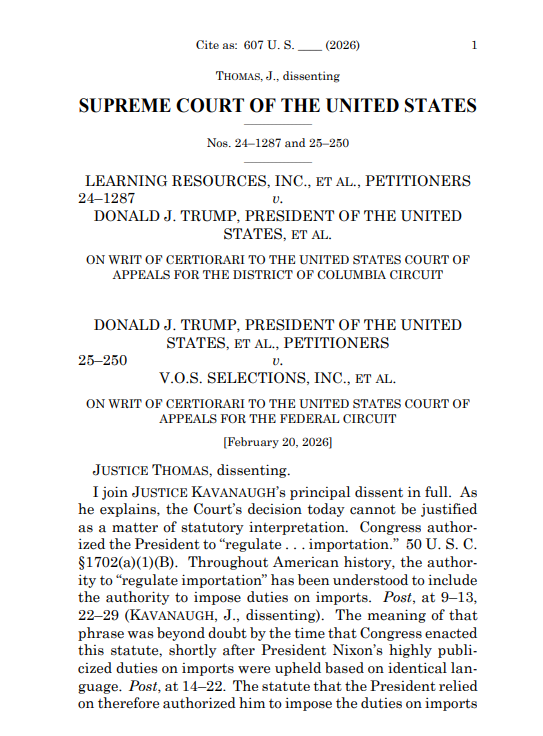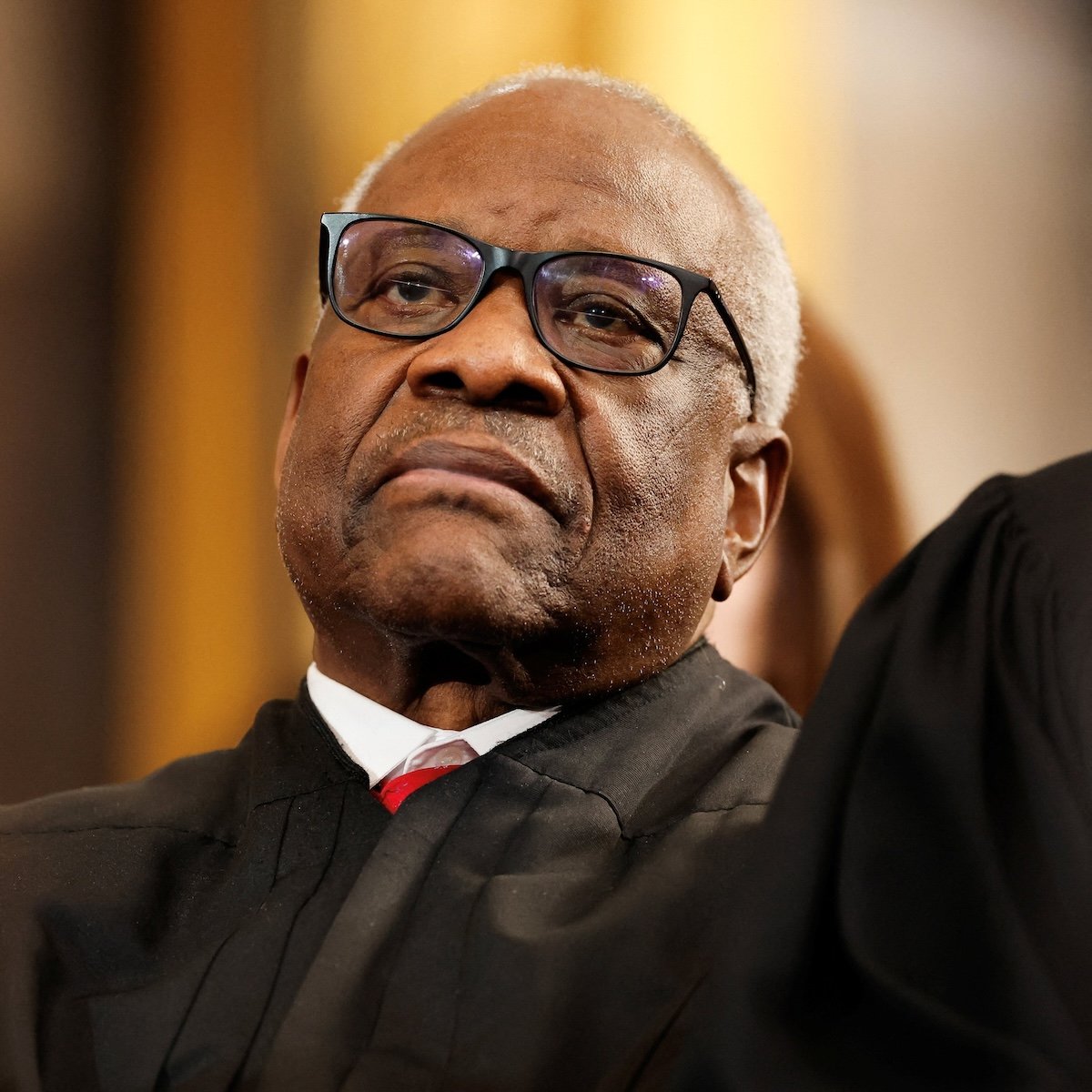

Justice Clarence Thomas delivered a forceful dissent after the Supreme Court of the United States blocked President Donald Trump from invoking emergency powers to impose sweeping tariffs, arguing the ruling conflicts with both statutory text and historical precedent.
In his opinion, Thomas wrote that neither federal law nor the Constitution justified limiting the president’s authority in the case.
“Neither the statutory text nor the Constitution provide a basis for ruling against the President,” Thomas stated, emphasizing that Congress explicitly authorized the executive branch to regulate imports.
He noted that throughout American history, the power to regulate importation has been understood to include the authority to impose duties, pointing to past examples where similar presidential actions were upheld. Thomas referenced trade actions taken during the Nixon era that courts sustained under comparable statutory language.
Thomas also argued that Congress has long delegated substantial authority to the president in economic and trade matters, stressing that such delegations have repeatedly been upheld by the courts.
“Because the Constitution assigns Congress many powers that do not implicate the nondelegation doctrine, Congress may delegate the exercise of many powers to the President,” he wrote, adding that lawmakers have done so “since the founding, with this Court’s blessing.”
The majority ruling limits the administration’s ability to use emergency authority to restructure trade relationships without additional congressional approval, a decision that could significantly affect future tariff policy and executive trade powers.
Thomas’s dissent is likely to be cited in future legal battles over the scope of presidential authority in economic policy, highlighting the continuing divide within the court over the balance of power between Congress and the executive branch.