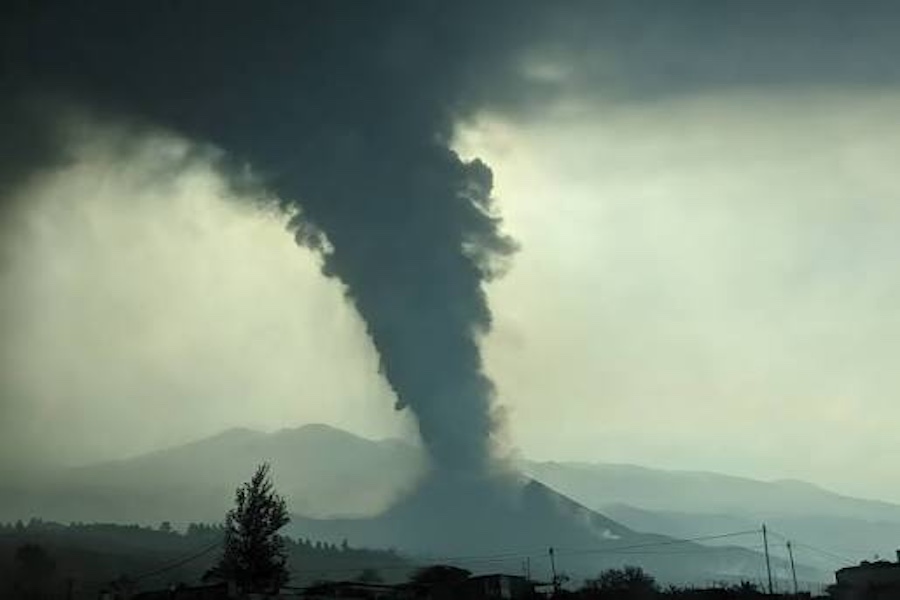

Scientists are increasingly sounding the alarm on the possibility that a large section of the western flank of Cumbre Vieja volcano on La Palma in Spain’s Canary Islands could fail and enter the Atlantic Ocean, which would then generate a tsunami capable of reaching the eastern coast of the United States.
The scenario centers on a steep rock mass, estimated in some studies at hundreds of cubic kilometers, that showed signs of partial detachment during a 1949 eruption. In the 1990s, research teams documented slow seaward movement of this material on the order of a centimeter or two per year.
“Based on extensive studies, I expect this part of the flank will eventually crash into the North Atlantic, launching a megatsunami in the process,” Volcanologist Bill McGuire wrote in a recent article published in BBC Science Focus.
“I have no doubt this will be a cataclysmic event, but have no idea when it will happen — it could easily be centuries or even millennia down the line,” he added.
McGuire pointed to ongoing scientific debate over the scale of effects, particularly whether substantial waves would reach North America. Computer models of a worst-case single-block collapse have projected an initial water displacement near the source reaching nearly a kilometer in height, with waves of around 65 feet arriving at Florida roughly nine hours later. Other estimates place wave heights along broader sections of the U.S. East Coast at roughly half that amount. Travel times are based on the speed of tsunami waves across open ocean, which can approach jet-aircraft speeds once the wave is generated.
‘Megatsunami’ could reach US East Coast in just hours after catastrophic volcano collapse in Spain, scientist claims https://t.co/JhyW7MmBwg pic.twitter.com/UmooKeKiNo
— Daily Mail US (@Daily_MailUS) November 6, 2026
Supporting observations cited by some researchers include large boulders deposited along Bahamian shorelines that are interpreted by certain geologists as material transported by ancient tsunamis originating in the Canary Islands. This interpretation is contested. Earlier modeling by Steven Ward and Simon Day in 2001 examined collapse volumes of 150 to 500 cubic kilometers moving at speeds near 100 meters per second and suggested waves of 10 to 25 meters could reach the Americas. Subsequent work has revised these figures downward.
The U.S. Geological Survey and other researchers have concluded that the original high-end scenarios overstate the far-field hazard. Ocean-floor mapping indicates that historical Canary Island flank collapses have typically occurred in multiple smaller increments rather than as single coherent events.
Slope-stability analyses indicate the volcano is currently stable and would need substantial additional growth before a large failure becomes more likely. Improved tsunami models that account for energy dissipation, bathymetry, and wave interactions project maximum wave heights of roughly three to seven feet along the U.S. East Coast under a worst-case collapse
No characteristic tsunami sediment deposits have been identified on the eastern coasts of North or South America that would corroborate repeated Atlantic-crossing megatsunamis from Canary Island sources, however.
Local hazards near La Palma and neighboring islands remain higher under any significant collapse. Collapses of this type occur on geological timescales of hundreds of thousands of years and are expected to be preceded by measurable increases in seismicity and ground deformation, McGuire noted.