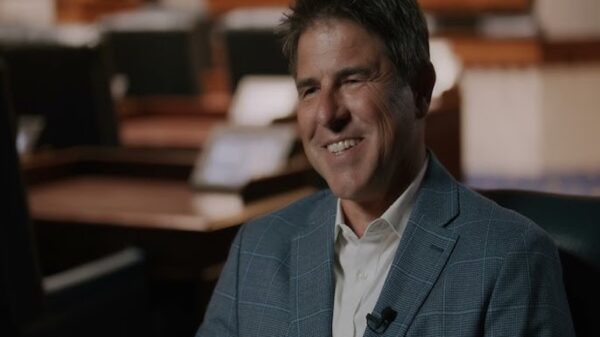
Longtime Fox News contributor Marc Thiessen is facing backlash from conservatives after President Donald Trump acknowledged that the war with Iran played a major role in Republicans’ midterm election losses, reviving scrutiny of Thiessen’s earlier predictions that the conflict would benefit the GOP.
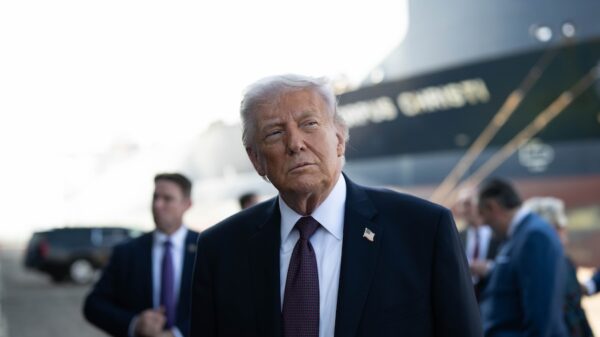
The controversy erupted following Trump’s interview with CBS News’ 60 Minutes, during which the president discussed the Republican Party’s devastating election results and the political consequences of rising gasoline prices.
Trump acknowledged that voters were frustrated with the war and its economic fallout, an assessment that closely mirrored Vice President JD Vance’s criticism of the administration’s handling of the conflict.
But the president’s remarks also sparked a dispute among prominent conservative commentators over whether Trump had criticized his vice president.
Donald Trump Jr. pushed back against that interpretation Monday morning, calling for the president’s full remarks to be presented.
President Trump on the midterms: “[Voters] didn’t like the war. They didn’t like the fact that gasoline went up… And there’s a great dislike, incredibly, for Israel.” https://t.co/eWb6x3xoJx
— Trump War Room (@TrumpWarRoom) November 9, 2026
“Play the full quote please.”
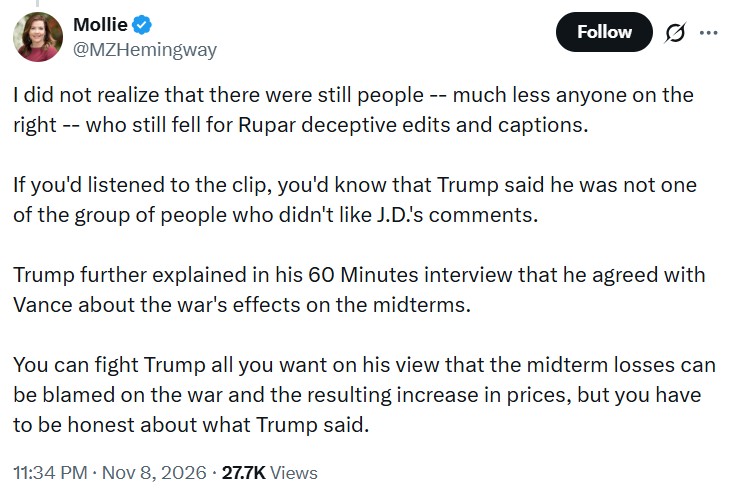
Federalist Editor-in-Chief Mollie Hemingway also criticized what she described as misleading edits of Trump’s interview, arguing that the president had not condemned Vance’s assessment.
According to Hemingway, Trump explained that some people were unhappy with Vance’s comments but made clear he was not among them.
She also emphasized that Trump agreed with the vice president’s assessment of the war’s impact on the midterms.
Screenshot-X
The president’s remarks came after Vance publicly blamed the conflict for Republican losses, arguing that Americans had grown frustrated with military operations overseas and the resulting financial pressure at home.
Trump similarly acknowledged that the war and higher gasoline prices had damaged Republican candidates, while maintaining that preventing Iran from obtaining nuclear weapons justified his administration’s actions.
The discussion prompted renewed scrutiny of conservative media figures who had previously championed the military campaign.
Screenshot-X
Federalist co-founder Sean Davis took aim at the Republican commentators who had predicted that the Iran conflict would strengthen Trump’s political position.
Tagging Thiessen and conservative radio host Mark Levin, Davis wrote:
“Really looking forward to the Thiessen/Levin rant about how Trump is disloyal to Trump for saying obvious things about the election that everyone with a brain knew were true five seconds after vote counts started coming in.”
Former Trump campaign adviser Steve Cortes also entered the debate, resurfacing footage of Thiessen discussing the Iran war during a May 2026 appearance on Fox Business.
In the clip, Thiessen encouraged Trump to make the conflict a central issue in the midterm campaign, predicting that Republicans would benefit politically.
“I think Donald Trump outta… campaign on it in the midterms. Point out the Democrats opposed it. By the time this is done, this is going to be a winner for Donald Trump in the midterm elections!”
The prediction came under renewed scrutiny after Democrats captured both chambers of Congress in Tuesday’s elections.
Cortes’ decision to resurface the footage highlighted the divide between conservatives who viewed military action against Iran as politically advantageous and those who warned that a prolonged conflict could damage Republican support.
Vance’s post-election analysis placed the war at the center of that debate, arguing that Republican voters wanted an end to the fighting, relief from rising living costs and a renewed emphasis on America First priorities.
Trump’s subsequent comments reinforced the distinction between defending the decision to confront Iran and acknowledging the political consequences of the conflict.
During his 60 Minutes interview, the president agreed that the war had contributed to Republican losses but maintained that he would make the same decision again to prevent Tehran from acquiring nuclear weapons.
The remarks challenged earlier predictions that the military campaign would provide Republicans with a decisive electoral advantage.
For Thiessen and other prominent supporters of the war, the criticism now centers on whether they underestimated voters’ concerns about gasoline prices, foreign military commitments and the direction of American foreign policy.
As Republicans examine their midterm defeats, the resurfaced May interview offers a reminder of how dramatically the political conversation surrounding the Iran war has changed.
Thiessen had predicted the conflict would become a Republican campaign asset. Following the election, Trump and Vance both acknowledged that it had become a significant political liability.