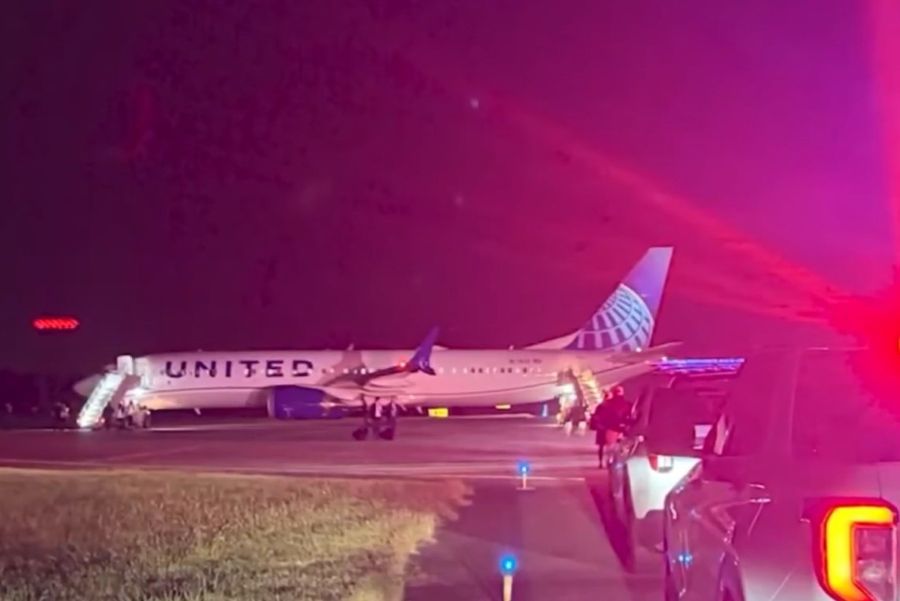

A United Airlines flight headed to New Orleans was met by law enforcement after a passenger allegedly made a bomb threat and the crew transmitted an emergency code associated with a possible hijacking.
United Flight 2174 was traveling from Newark Liberty International Airport in New Jersey to Louis Armstrong New Orleans International Airport when the frightening situation unfolded.
The Boeing 737 MAX 9 transmitted a squawk code of 7500, an aviation emergency signal used to alert air traffic controllers to unlawful interference aboard an aircraft.
Despite the alarming circumstances, the pilots successfully landed the aircraft without incident, bringing all 46 passengers and six crew members safely to the ground.
The incident reportedly involved a disruptive male passenger who threatened to detonate a bomb aboard the flight.
According to aviation observer Aaron Heins, who reviewed air traffic control communications and aircraft messaging, the suspect was described as wearing black clothing and carrying a backpack.
Heins reported that the man “who spoke almost no English” allegedly made the threat while the aircraft was approaching its destination.
Those details have not been independently confirmed by law enforcement.
Flight attendants reportedly kept the passenger toward the rear of the aircraft as the pilots coordinated their arrival with air traffic controllers.
🚨 #UPDATE: Police have released the name of the suspect accused of making a bomb threat aboard United Airlines Flight UA2174 late Monday night.
34 year-old ‘Ronnie Gomez Alberto’ was arrested after allegedly telling flight crew members he had a bomb on board while the plane was traveling from Newark to New Orleans.
According to the Jefferson Parish Sheriff’s Office, the incident happened around 11:20 p.m. The flight attendants, despite a language barrier, convinced him to move to the back of the aircraft.
The plane landed safely at Louis Armstrong International Airport and was moved to a separate location. Alberto remained aboard, reportedly wanting to “negotiate”, before he was eventually taken into custody.
Alberto faces charges of communicating false information of planned arson and terrorizing.
— zach bitango (@ZachBitango) November 10, 2026
Meanwhile, communications from the aircraft suggested the situation may have involved something even more serious than a verbal threat.
An Aircraft Communications Addressing and Reporting System message, commonly known as ACARS, indicated a possible attempt to breach the cockpit.
“WE HAD AN ATTEMPTED LEVEL 4 NO OTHER DETAILS ARE KNOWN AT THIS TIME,” the crew reportedly wrote.
In aviation security terminology, a Level 4 threat involves an attempted or actual breach of the flight deck, where pilots operate the aircraft.
POLL: Do You Stand With Pete Hegseth Against The Dems Trying To Impeach Him?
Such incidents are considered particularly serious because unauthorized access to the cockpit could threaten the safety of everyone aboard.
However, authorities have not publicly confirmed that the passenger attempted to enter the cockpit, and the circumstances surrounding the reported message remain unclear.
After landing in New Orleans, the aircraft was directed to a remote parking location away from regular airport operations.
Law enforcement officers responded to the aircraft as authorities worked to address the reported security threat.
The individual involved was reportedly taken into custody, although officials have not released details about his identity or potential criminal charges.
United Airlines confirmed that the flight landed safely following a disturbance involving a passenger.
The airline said the aircraft “landed safely following a disruptive incident involving a passenger onboard.”
“Law enforcement met the aircraft upon arrival,” United added.
The airline did not immediately provide further details about the passenger’s alleged actions or explain what prompted the crew to transmit the emergency code.
No injuries were reported among the passengers or crew.
It also remains unclear whether investigators discovered any suspicious materials aboard the aircraft or determined that the reported bomb threat was credible.
The incident has drawn attention because the 7500 emergency code is specifically associated with unlawful interference, distinguishing it from the more general 7700 emergency signal used for other serious situations.
The reported cockpit security alert further heightened concerns about what happened during the flight.
Despite those warnings, the crew maintained control of the aircraft and completed the journey safely.
The New Orleans incident follows another recent aviation emergency involving a Southwest Airlines flight traveling between California cities.
Southwest Flight 3396 was headed from Santa Ana to San Jose when the crew declared a general emergency at approximately 20,000 feet.
The aircraft diverted to Los Angeles International Airport following what appeared to be a mechanical problem.
Unlike the United Airlines incident, the Southwest emergency was not associated with a reported security threat or attempted hijacking.
“The Pilots followed established procedures and landed the aircraft uneventfully,” Southwest said in a statement.
As for the New Orleans-bound United flight, the airline has confirmed that everyone aboard arrived safely.
Authorities have not yet publicly established the full sequence of events, including whether the reported bomb threat was accompanied by an actual attempt to enter the cockpit.