
Saudi Arabia has announced the establishment of the Multinational Maritime Defense Alliance, a framework for collective maritime defense cooperation focused on the Bab al-Mandab Strait, the Red Sea, and the Gulf of Aden. The announcement follows years of insecurity in the vital sea lane due to threats from the Iran-backed Houthi militant group.
The announcement followed a meeting hosted in Riyadh by the Saudi Ministry of Defense, attended by chiefs of staff and representatives from 43 countries along with a European Union delegation. Of the 51 countries and organizations invited, these participants discussed the proposed alliance’s draft charter, organizational structure, command-and-control arrangements, operational mechanisms, and next steps.
As part of the agreement, 14 countries issued a joint declaration supporting the alliance as founding members. This includes Saudi Arabia, Kuwait, Bahrain, Qatar, Pakistan, Türkiye, Egypt, Jordan, Yemen, Bangladesh, Nigeria, Sudan, Djibouti, and Somalia. The United Arab Emirates and Oman were notably not among those listed in the initial joint statement.
The Saudi Ministry of Defense noted that the door remains open for additional countries to join once they complete their national procedures, and that other participating states had expressed support pending such steps.
“The founding states of the Multinational Maritime Defense Alliance that met in Riyadh on July 30, 2026, reaffirm their firm commitment to the principles of the United Nations Charter, international law, and recognized global maritime customs. Recognizing the growing challenges to global maritime security and the necessity of strengthening collective defense cooperation to protect freedom of navigation, secure international trade routes, and safeguard energy supply lines across the Bab al-Mandab Strait, the Red Sea, and the Gulf of Aden, the member states affirm that maritime security is a shared responsibility and that cross-border coordination remains the cornerstone for confronting common threats and enhancing global stability,” the joint declaration reads.
“The founding states have agreed to and adopted the following: Establishing the alliance as a defensive framework, prioritizing enhancing maritime security, protecting freedom of navigation, securing international trade routes and energy supply lines, and safeguarding shared maritime interests in the Bab al-Mandab Strait, the Red Sea, and the Gulf of Aden, in accordance with international law, United Nations conventions, and international custom,” the statement continued.
In order to implement the agreement, member states moved to establish a joint command, command and control center, combined maritime operational center and a general secretariat in Saudi Arabia as the alliance’s primary executive bodies. The framework further emphasizes intelligence sharing, joint maritime operations, and exercises among participants, while leaving operational involvement as a decision for each sovereign state.
Army chiefs from countries in the Maritime Defense Coalition met in Saudi Arabia today to maintain freedom of navigation in the Bab al-Mandab Strait, as Riyadh seeks to build an international coalition to protect Red Sea shipping from Houthi attacks.
Participating nations:… pic.twitter.com/Vcvxw2Xacd
— Open Source Intel (@Osint613) July 30, 2026
Friday’s announcement comes just a little over a week after the Houthis announced they would impose a maritime blockade against Saudi Arabia in the Red Sea. The group has since claimed responsibility for a series of attacks on Saudi-linked shipping in recent weeks, which follows the collapse of a prior truce that was brokered in conjunction with the United States.
The Red Sea corridor, including the Bab al-Mandab Strait at its southern entrance and connections northward via the Suez Canal, forms a key maritime route linking the Indian Ocean and Mediterranean. It has historically carried approximately 10 to 12 percent of global seaborne trade, along with substantial volumes of crude oil, petroleum products, and liquefied natural gas.
In 2023, an estimated 8.7 million barrels per day of crude oil and petroleum products transited the Bab al-Mandab Strait, according to data from the U.S. Energy Information Administration, with related Suez Canal and SUMED pipeline flows accounting for a significant share of seaborne oil movements to Europe and other markets.
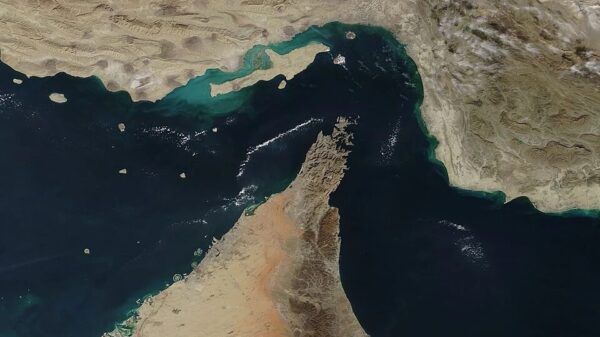
Reliance on the vital sea lane has increased since the start of the Iran conflict and related impacts on the Strait of Hormuz.
POLL: Should Foreigners Be Banned From Buying American Farmland?