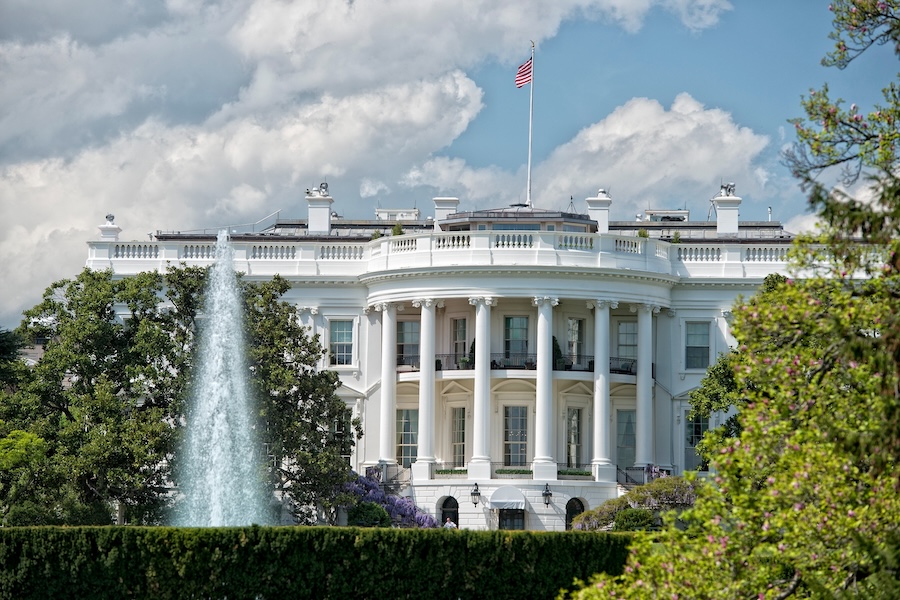

A federal appeals court dealt President Donald Trump a major setback Friday, ordering most construction on his planned White House ballroom to stop in a 2-1 ruling.
The U.S. Court of Appeals for the D.C. Circuit said Trump may continue certain below-ground work tied to security, but blocked the broader project while the legal fight moves forward.
The ruling gives the administration two weeks to seek emergency relief from the Supreme Court.
The majority argued that Congress maintains authority over funding and development at the White House and had not specifically authorized Trump’s sweeping ballroom project.
“We are aware of no instance in American history in which a President unilaterally and using privately collected funds demolished substantial portions of the White House that Congress authorized to be built and American taxpayers paid for. Until now,” the majority wrote.
The decision broke along ideological lines.
U.S. Circuit Judges Patricia Millett, an appointee of former President Barack Obama, and Brad Garcia, an appointee of former President Joe Biden, formed the majority.
U.S. Circuit Judge Neomi Rao, a Trump appointee, dissented and accused the court of inserting itself into a matter that should not be under judicial control.
🚨 JUST IN: A federal Appeals court has just ordered President Trump STOP ALL CONSTRUCTION on the White House ballroom before he gets Congressional approval — AP
SUPREME COURT TIME.
This is TOTAL BS.
SCOTUS should step in, slap it down, so construction can proceed! 🔥 pic.twitter.com/Ux4VM80BPX
— Eric Daugherty (@EricLDaugh) August 7, 2026
Rao also argued that the preservation group challenging the project did not have proper standing to sue.
“The district court seized supervision of construction at the White House, and my colleagues affirm this judicial overreach,” Rao wrote. “Because the injunction is beyond the proper province of the federal courts, construction should be allowed to continue.”
POLL: Do You Approve Of Secretary Of War Pete Hegseth?
Trump demolished the East Wing last fall to clear the way for the planned 90,000-square-foot ballroom, one of several ambitious projects tied to his effort to reshape Washington during his second term.
The president has also pushed plans involving a golf course, a new arch, the Kennedy Center and the Lincoln Memorial Reflecting Pool.
Several of those projects have faced legal challenges as opponents turn to the courts to slow or block Trump’s plans.
The White House has argued that the ballroom is not simply decorative.
Trump has repeatedly cited national security concerns following shootings near presidential locations and has said the project would include major security infrastructure.
Among the planned additions are a drone port and a military facility.
The administration has also argued that Congress should not have veto power over the project because private donations, rather than taxpayer dollars, are funding the ballroom.
The project is expected to cost hundreds of millions of dollars, with major corporations and private donors contributing toward construction.
Trump has repeatedly blasted the National Trust for Historic Preservation, which brought the lawsuit, arguing that the group lacks standing to interfere with work at the White House.
Friday’s decision still leaves one significant opening for the administration.
Below-ground construction connected to security may continue, and limited above-ground work will also be allowed when strictly necessary to protect those installations.
The D.C. Circuit had previously allowed construction to continue for months while the case played out.
Now, Trump’s next move could take the fight directly to the Supreme Court, where the administration will have two weeks to seek emergency intervention before the appeals court’s broader construction ban takes effect.
POLL: Ilhan Omar Now Claims She’s Broke – Do You Believe Her?