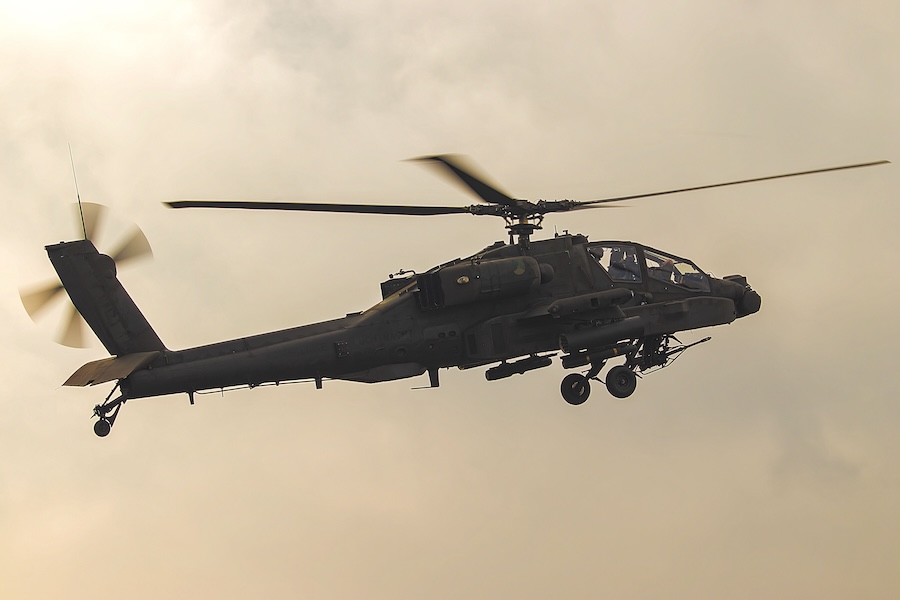

A U.S. Army AH-64 Apache helicopter crashed near the strategically vital Strait of Hormuz on Monday, prompting a dramatic rescue operation that successfully recovered both crew members after they spent roughly two hours in the water.
U.S. Central Command confirmed that the helicopter went down during a patrol mission off the coast of Oman, near Iranian waters, though officials have not yet determined what caused the incident. The crew members were rescued alive and are reported to be in stable condition.
The crash comes at a particularly tense moment in the Middle East, as the United States, Israel and Iran continue to navigate a fragile ceasefire following months of military confrontation. While some early reports raised questions about whether hostile fire may have played a role, military officials stressed that the cause remains under investigation and no conclusions have been reached.
President Donald Trump told reporters that the pilots were “fine” and indicated that a full incident report would be released once investigators complete their initial assessment. “Nobody injured. We are going to issue a report tomorrow. But the pilots are fine.”
One of the most remarkable aspects of the rescue operation was the technology used to save the crew. A U.S. Navy unmanned surface vessel, commonly referred to as a drone boat, played a key role in locating and recovering the stranded aviators.
Military officials described the mission as a historic first, marking the first known rescue of American personnel by an unmanned maritime system during an active military operation. The drone vessel was supported by additional U.S. naval and air assets operating in the region.
via X
The Strait of Hormuz remains one of the most strategically important waterways in the world, serving as the gateway for roughly one-fifth of the global oil supply. The narrow passage connects the Persian Gulf to the Gulf of Oman and has long been a focal point of tensions between Iran and the United States due to its critical role in international energy markets.
To safeguard commercial shipping and deter potential threats, U.S. military aircraft routinely patrol the region. The helicopter involved in the incident was an AH-64 Apache, one of the military’s premier attack helicopters and a cornerstone of American combat operations for decades.
Designed for high-intensity warfare, the Apache is equipped with advanced targeting systems, heavy armor, and precision-guided weapons, including Hellfire missiles. The aircraft is widely regarded as one of the most capable attack helicopters in the world and regularly operates in high-threat environments where American forces face elevated risks.
The loss is especially notable given the broader conflict that began on February 28. Iran has claimed responsibility for downing roughly 30 U.S. MQ-9 Reaper drones, while several American fighter aircraft have also been lost due to combat incidents and friendly-fire accidents according to The New York Times who first reported on the crash.
If confirmed, the crash would mark the first AH-64 Apache lost during the war.
Apache crews have played a critical role in protecting maritime traffic through the Strait of Hormuz, helping counter drone threats and fast-attack boats that could endanger commercial vessels. In recent months, however, U.S. helicopters have been operating increasingly close to Iranian-controlled territory, including islands scattered throughout the strait and the Persian Gulf.
Those expanded patrols reflect the more aggressive posture adopted by U.S. Central Command as tensions with Tehran have intensified. The missions have continued even as diplomatic efforts aimed at securing the full reopening of the strategic waterway have progressed in fits and starts.